
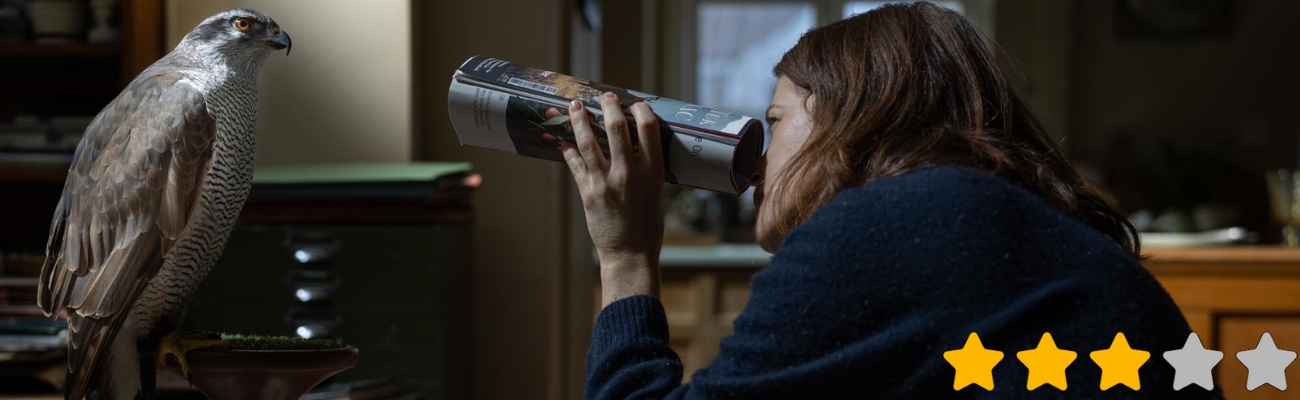
H is for Hawk (dir. Philippa Lowthorpe)

Certificate: 12A
Running Time: 115 mins
UK Distributor: Lionsgate
UK Release Date: 23 January 2026
WHO’S IN H IS FOR HAWK?
Claire Foy, Brendan Gleeson, Sam Spruell, Josh Dylan, Denise Gough, Emma Cunniffe, Arty Froushan, Lindsay Duncan
WHO’S BEHIND THE CAMERA?
Philippa Lowthorpe (director, writer), Emma Donoghue (writer), Dede Gardner, Lena Headey and Jeremy Kleiner (producers), Emilie Levienaise-Farrouch (composer), Charlotte Bruus Christensen (cinematographer), Nico Leunen (editor)
WHAT’S IT ABOUT?
A grieving academic (Foy) finds solace in training a wild goshawk…
WHAT ARE MY THOUGHTS ON H IS FOR HAWK?
The role of support animals in people’s lives, especially those suffering from severe mental health such as depression, anxiety or even just loneliness, can be extremely powerful. What better thing to confide in when you’re at your lowest than a cuddly cat or a delightful dog? Or even – in the case of one Helen Macdonald, the British writer whose memoir H is for Hawk is now adapted by director and co-writer Philippa Lowthorpe – a fierce, carnivorous goshawk.
As Lowthorpe’s film suggests, even one of the deadliest birds of prey in the animal kingdom can provide all the comfort one could need to move past or even stay within their fragile mental state. But even then, it may not necessarily solve one’s problems and could possibly make them worse, which the film certainly touches upon though doesn’t quite drill all the way to the centre, so as to remain a fairly light but still watchable drama for audiences wanting something gentle and comforting to absorb. A support animal for movie audiences, if you will.
Taking place in 2007, we open with Helen (Claire Foy), a Cambridge research fellow, learning that her beloved father, photojournalist Alastair Macdonald (Brendan Gleeson), has suddenly passed away. This sends Claire into a deep pit of despair, one that she initially tries filling with meaningless self-help books and one-night stands, but soon she’s inspired – primarily by her late father’s fascination with bird-watching, among other things – to purchase and train a goshawk, which she names Mabel. At first, it seems that taming the deadly bird is exactly what Helen needs to cope with her grief, but quickly it transpires that Mabel is taking up way too much of her time, to a point where she starts falling behind on the things that matter the most.
As with the vast majority of movies dealing with grief and depression, H is for Hawk merely pecks the surface in its attempted exploration of said topics. Lowthorpe and co-writer Emma Donoghue are quick to place Foy’s Helen in her depressive state, with much of the first act dedicated to our protagonist wallowing in despair, going through many of the expected motions such as sitting around in her house looking sad and flashing back to happier times with her father (Gleeson’s scenes are, of course, largely relegated to these flashbacks). However, while Foy is excellent in these scenes, showing a more vulnerable and reckless side to her screen persona than in her more reserved previous roles, they often meander with little purpose, always on the verge of full-blown melodrama but lacking the narrative drive for many of these moments to land with authenticity.
Naturally, once the hawk of the title comes into the picture, things get more interesting. There’s a fearsome yet majestic screen presence to this very well-trained bird that’s playing Mabel, and its chemistry with Foy is surprisingly powerful, their wordless encounters shot and performed in such a way that you almost mistake it for romantic tension between the two performers. Scenes of Mabel being trained and let loose unto the wilderness are also visually dazzling, as Charlotte Bruus Christensen’s cinematography captures the hawk’s flight toward its prey like it’s a nature documentary, to where very much like your typical David Attenborough outing you wonder how exactly they were able to film so much of this while still making it feel so natural and even quite thrilling. There are even some intriguing sections where Helen’s dependency on Mabel becomes overwhelming, as the academic effectively becomes a shut-in with her house piling up with rotting meat and unwashed mugs, almost as though Mabel is some kind of drug that Helen has become mercilessly addicted to in order to escape from her reality (H is for Heroin could legitimately be an alternative title for this movie).
However, the film still has a problem with how lightly it treats the heavier themes, in a script that struggles to fully comprehend the fragile mental state of its human lead. There isn’t much progress to Helen shutting herself off from the world on account of her pet hawk, it just starts happening, and as a result you’ll have scenes of her ignoring the house calls of friends and family that feel not necessarily out of character but wildly unusual for someone who up to that point had been at least functional as a person going through personal loss. The script also finds awkward ways to crowbar in conversations of death, the worst offender being a lecture Helen gives on Mabel’s deadly nature that’s constantly interrupted by irritatingly self-righteous students, whose only purpose is to goad her into a public display of frustration, armed with enough buzzwords and gotcha moments to pass as extras from the 2019 Black Christmas remake.
Although it never manages to convince as a full-scale depiction of mental health, H is for Hawk does have enough good intentions and handsome filmmaking, not to mention Claire Foy being great as ever, for it to be a serviceable adaptation. It’s light viewing, perhaps too light for its own good, but if nothing else it’ll convince you to find your own support animal that can be as ferocious as Mabel the goshawk.
SO, TO SUM UP…
H is for Hawk is a beautifully shot adaptation of Helen Macdonald’s memoir that shines whenever an excellent Claire Foy shares scenes with her impeccably trained avian co-star, but much less so with its surface-level depiction of grief and depression that the light script isn’t strong enough to dig deeper into.



Other recent reviews:









0 Comments