
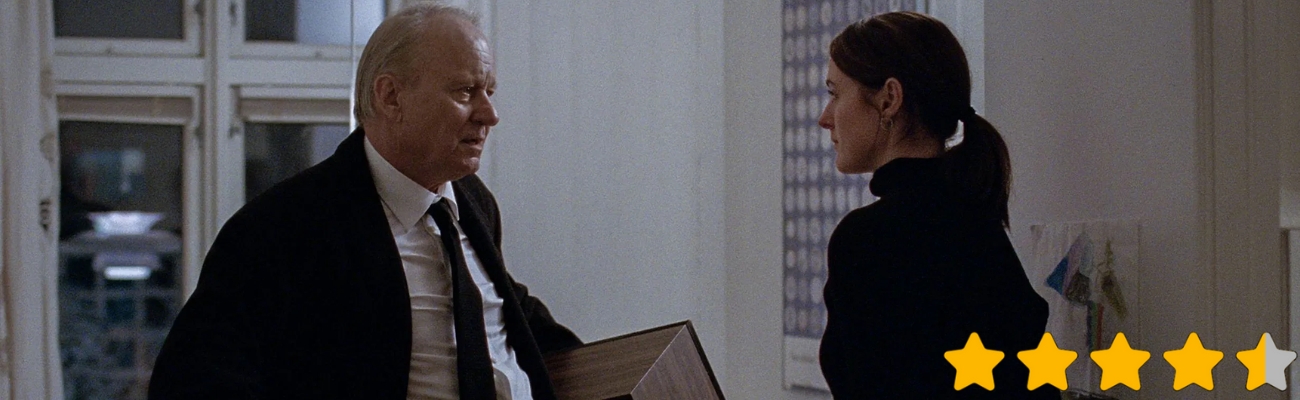
Sentimental Value (dir. Joachim Trier)

Certificate: 15
Running Time: 133 mins
UK Distributor: MUBI
UK Release Date: 26 December 2025
WHO’S IN SENTIMENTAL VALUE?
Renate Reinsve, Inga Ibsdotter Lilleaas, Stellan Skarsgård, Elle Fanning, Cory Michael Smith, Catherine Cohen, Anders Danielsen Lie, Andreas Stoltenberg Granerud, Øyvind Hesjedal Loven
WHO’S BEHIND THE CAMERA?
Joachim Trier (director, writer), Eskil Vogt (writer), Maria Ekerhovd and Andrea Berentsen Ottmar (producers), Hania Rani (composer), Kasper Tuxen (cinematographer), Olivier Bugge Coutté (editor)
WHAT’S IT ABOUT?
An actor (Reinsve) is forced to confront her distant filmmaker father (Skarsgård)…
WHAT ARE MY THOUGHTS ON SENTIMENTAL VALUE?
A word of warning for those who adored filmmaker Joachim Trier’s previous film The Worst Person in the World: his latest, Sentimental Value, is absolutely not that.
A far different beast to the irreverent and occasionally surreal dramady which launched lead actor Renate Reinsve into the international spotlight and pushed Trier himself further into it, Sentimental Value applies a far more sombre and melancholic tone that aims to get even deeper under the skin of its audience and take them on an exceptionally emotional journey. It’s not without a few moments of comedy – especially a hilarious gag involving, of all things, the definitely non-comedic films Irreversible and The Piano Teacher – but by and large, this is very much a straightforward drama in the same vein of Ingmar Bergman.
And it is, like the majority of Bergman’s work, quite masterful in how it composes genuine emotion amidst such relatable yet almost fantastical circumstances. Trier’s film is exceptionally written, brilliantly performed and, most of all, deeply empathetic to each one of its main characters, to where this may well be the Scandinavian filmmaker’s own quiet masterpiece that outpaces even The Worst Person in the World with its own sense of human connection.
The film focuses on a fractured family in Oslo, specifically Nora (Reinsve), a stage actor who often finds herself overcome with anxiety moments before stepping foot on stage, and her younger sister Agnes (Inga Ibsdotter Lilleaas) who has a more settled life with a family and a steadier job. Both are reeling from the recent death of their mother, as well as the childhood departure of their father Gustav (Stellan Skarsgård), a once-prominent filmmaker who’s written a deeply personal script he intends to shoot in their old family house, and more importantly wants none other than Nora to play the lead role. But after Nora flatly refuses to have any part in the project, Gustav instead offers the part to Hollywood starlet Rachel Kemp (Elle Fanning), further widening the rift between him and his daughters, especially Nora whose own insecurities stem far deeper than just her father’s early abandonment.
The earlier comparison to Bergman is apt, for Sentimental Value shares a spiritual connection to the filmmaker’s work, specifically his late-career feature Autumn Sonata which similarly finds an aged artistic talent attempting to reconnect with their estranged offspring, though Trier’s film offers a slightly more thorough exploration of the fragility amongst its main characters which arguably makes it more palatable than the Bergman film. Here, each family member is forced to reckon with past trauma, be it their own or the kind they have inherited from past family members, some of whom were subjected to horrific torture by the Nazis during the war, which itself led to tragedy that shaped certain characters in the present. Trier carefully applies unto them all a fair number of layers which simultaneously hide their greater insecurities and expose their compulsive flaws, from Gustav’s self-serving ambition to Nora’s overwhelming isolation, with even the comparatively more balanced Agnes wrestling with her own sense of guilt for allowing her family to be pulled apart at the rate that it has.
Trier also co-wrote the film with Eskil Vogt, both of whom also worked together on the director’s so-called Oslo Trilogy (which includes The Worst Person in the World as its third and final entry), and while their script for Sentimental Value might not be as playful or even as provocative as the ones for those movies, it certainly feels their most accomplished. Theirs a calmly engrossing story of family, forgiveness and self-reckoning that feels universal in how it addresses a variety of psychological issues that its multi-dimensional characters face, while still making them interesting enough for the viewer to want to see more of them in action. Through concise dialogue, some of it delivered via narration, we learn a great deal about these characters and their histories yet not so much where it feels like we know more than we’d like to, leaving more than enough for the viewer to piece together facts about them which explain their current state of melancholia.
The performances are across the board exceptional, with Reinsve and Lilleaas forming a believable sisterly bond where you feel the drastic weight of their shared trauma despite their contrasting ways of dealing with it. Meanwhile, a never-better Skarsgård uses his natural screen charisma as a weapon in scenes where he can be ruthless but also genuinely remorseful as someone who is doing whatever he can to transfer his own haunted past onto the screen, even if it means exploiting members of his own family. Special credit also goes to Fanning, who is delightful in a role that could have easily come across as this spoiled Hollywood darling who’s out of her depth, but she too lends Rachel Kemp a strong sense of humanity as she slowly learns not just her own limits but also that of her new director, whose personal attachment to the project is so strong that he starts to mould the American actor in the image of his own flesh and blood.
It’s a strikingly emotional film that genuinely feels like something Ingmar Bergman would have made if he was still around, though Trier proves himself to be a worthy spiritual successor. Much like the works of Bergman, Sentimental Value is alive with empathy and complex humanity, enough to leave you in a reflective but also thankful mood toward your own insecurities, for they shape us as much as they do the deeply fragile characters at its centre.
SO, TO SUM UP…
Sentimental Value is a strikingly emotional family drama that sees filmmaker Joachim Trier evoke the spirit of Ingmar Bergman with a well-written, exceptionally performed and profoundly empathetic study of fragile relations.



Other recent reviews:





0 Comments