
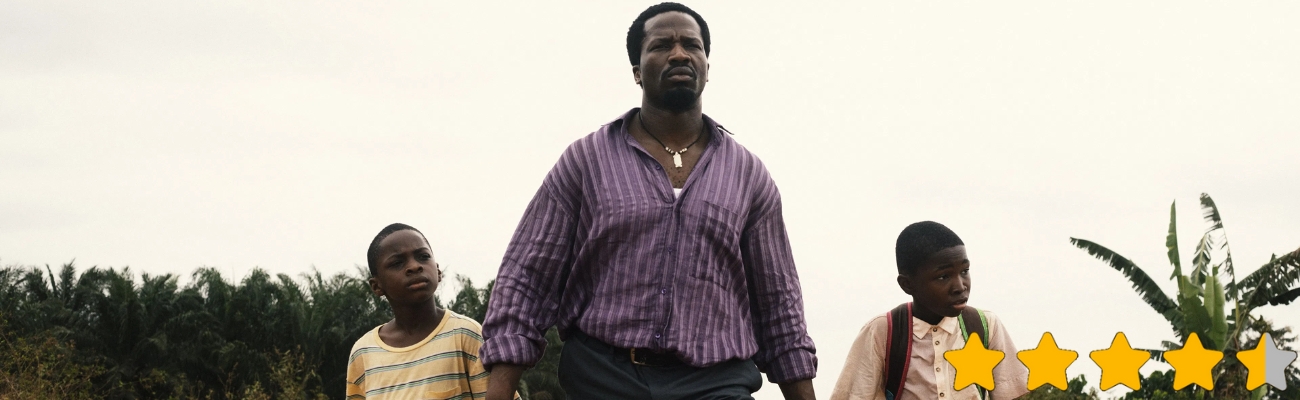
My Father’s Shadow (dir. Akinola Davies Jr.)

Certificate: 12A
Running Time: 93 mins
UK Distributor: Mubi
UK Release Date: 6 February 2026
WHO’S IN MY FATHER’S SHADOW?
Ṣọpẹ́ Dìrísù, Godwin Chiemerie Egbo, Chibuike Marvellous Egbo, Efòn Wini, Tosin Adeyemi, Adesina McCoy Babalola, Lawrence Chu
WHO’S BEHIND THE CAMERA?
Akinola Davies Jr. (director, writer), Wale Davies (writer), Rachel Dargavel and Funmbi Ogunbanwo (producers), CJ Mirra and Duval Timothy (composers), Jermaine Edwards (cinematographer), Omar Guzmán (editor)
WHAT’S IT ABOUT?
In 1993 Nigeria, two young boys (Egbo and Egbo) spend the day with their estranged father (Dìrísù)…
WHAT ARE MY THOUGHTS ON MY FATHER’S SHADOW?
At one point in director and co-writer Akinola Davies Jr.’s debut feature My Father’s Shadow, it unexpectedly becomes a zombie film. Not in the traditional sense, mind, but still rather alike in tone and presentation as a group of armed men suddenly run shouting down a beach towards a young boy. Fortunately, he turns out not to be their target, but instead the previously unseen whale that’s washed up on the shore, which they promptly strike and prod with any weapons they have as they harvest its guts. It’s a terrifying moment, even without any actual zombie carnage, as it personifies the desperate chaos of a country at a point in time when stability and morality was on the edge of a cliff, constantly being speared by corrupt forces trying to push off all traces of its democracy and integrity.
It’s no coincidence that the scene comes immediately after an exceptionally emotional monologue that goes into heavy extended detail about the burdens and regrets of parenthood, for it too is symbolic of how these particular themes within this incredibly moving film go hand in hand with the political turmoil that’s constantly dominating the background. The combination gives Davies Jr.’s film a striking richness that is full of heart, complexity and unexpected humour, all while delivering a sharp snapshot of a father-son(s) relationship that might well move anyone to tears, regardless of their parental status.
Taking place during a single day in 1993 Nigeria, as ballots are still being counted for the country’s presidential election, we open with young boys Aki and Remi (played by real-life brothers Godwin Egbo and Chibuike Marvellous Egbo) playing together while they wait for their mother to return home from the nearby village. Both are surprised to see their father Fola (Ṣọpẹ́ Dìrísù) suddenly reappear, him having been largely absent while he works in the city of Lagos, and even more surprised when he says that he has to return to the city immediately, but not before inviting his sons to come with him for the day. So begins their day together, as the boys wander about Lagos and get to see glimpses of who their father actually is, one who’s respected and admired by most people in the district, but also – like most people living under the country’s military dictatorship – eager for change as the opposing presidential candidate is on course for an easy election win.
Of course, anyone familiar with the outcome of that particular election will know all too well how those hopes pan out. But Davies Jr. doesn’t exactly turn his film into a history lesson for those who don’t, nor does he offer commentary on the deeply divisive political moment that hasn’t already been said. Rather, the director – who also co-wrote the semi-autobiographical script with his own brother Wale Davies – positions it as a formidable political backdrop coated in grainy film-stock cinematography, setting the stage for a much deeper exploration of a country that is always on the verge of collapse, as told through the eyes of children too young to understand what’s happening.
To them, the ruthless military presence and election interference matters much less than it does to their father, who has clearly seen up close the horrors that the ruling forces are capable of, so much so that he automatically gets a nosebleed whenever confronted with the mere memory of it. However, the same could also be said about other adults who are either too consumed by the propaganda or too naïve to think that such brutish force will be immediately undone by simple democracy. The film presents a slippery slope towards authoritarianism that feeds itself on the blissful ignorance of children and adults alike, which as history proves never works out for anyone not in a position of power, and here provides a harrowing background detail that is always on the viewer’s mind, even during the most tender scenes of these kids enjoy spending long overdue time with their father.
The father-children dynamic is where the film’s heart truly lies, as these boys – played so naturally by these young actors – revel in the presence of a parent they hardly know at all, but come to find that his absence is not a true indication of how much he genuinely cares for his sons. Dìrísù, in a fantastic central performance, shows how Fola’s great strength lies in his unexpected prowess as a parental figure, immediately commanding his own sense of authority in front of his boys while displaying a booming charisma when running into close friends and family members, all of whom offer brief yet vital insights into his true, much more vulnerable identity. It’s made exceptionally clear how much respect is given to him by not just his sons but anyone who crosses his path, but the film stops short of lionising him as his sternness and sometimes his own vices present him as someone who is certainly flawed yet always trying to do what is right for the sake of his kids.
Seeing them all together operating underneath such a natural and warmly inviting dynamic, all while severe unrest is just waiting to erupt around them, is the true highlight of My Father’s Shadow, to where its powerfully conveyed and deeply humanist study of a country in crisis is enough to leave a big lump in your throat by the bittersweet end. Davies Jr. has crafted a film that, despite sometimes being a little repetitive and reliant on one or two jarring time-jumps, is as emotional as it is urgent, if sometimes especially when over thirty years later some of the world’s most stable democracies are in danger of collapsing upon themselves.
SO, TO SUM UP…
My Father’s Shadow is a harrowing study of Nigerian political unrest paired with a deeply moving father-child bonding drama, both of which are excellently portrayed through a complex and humanist script co-written by director Akinola Davies Jr., and performed brilliantly by Ṣọpẹ́ Dìrísù and his two young co-stars who are a joy to watch together.



Other recent reviews:


0 Comments