Nouvelle Vague (dir. Richard Linklater)

Certificate: 12A
Running Time: 106 mins
UK Distributor: Altitude Films
UK Release Date: 30 January 2026
WHO’S IN NOUVELLE VAGUE?
Guillaume Marbeck, Zoey Deutch, Aubry Dullin, Bruno Dreyfürst, Benjamin Clery, Matthieu Penchinat, Pauline Belle, Blaise Pettebone, Benoît Bouthors, Paolo Luka Noé, Adrien Rouyard, Jade Phan-Gia, Jodie Ruth-Forest, Antoine Besson, Franck Cicurel, Roxane Rivière, Jean-Jacques Le Vessier, Côme Thieulin, Laurent Mothe, Jonas Marmy, Niko Ravel
WHO’S BEHIND THE CAMERA?
Richard Linklater (director), Michèle Halberstadt (writer, producer), Holly Gent, Laetitia Masson and Vincent Palmo Jr. (writers), Laurent Pétin (producer), David Chambille (cinematographer), Catherine Schwartz (editor)
WHAT’S IT ABOUT?
French film critic Jean-Luc Godard (Marbeck) decides to make his own movie, titled Breathless…
WHAT ARE MY THOUGHTS ON NOUVELLE VAGUE?
Richard Linklater’s filmography is so versatile that he can go from crowd-pleasing comedies like School of Rock and Hit Man to awards-calibre projects like Blue Moon and now Nouvelle Vague without batting an eyelid, and even more fascinating is the fact that he pretty much nails every single radical shift in direction. The latter is especially representative of a filmmaker like Linklater applying everything that he clearly loves about a particular style of filmmaking, specifically in this case the traits commonly found in the films of the French New Wave, to a cinematic homage that manages to be both within his directorial wheelhouse but also unlike the majority of what he’s done before.
Linklater’s passion for the French New Wave and its many vibrant personalities, none more so than Jean-Luc Godard who with his debut feature Breathless helped usher in an all-new era of filmmakers undeterred by traditional rules and regulations, clearly fuels Nouvelle Vague and the playful energy that it emits from its stylish engine. Beyond that, this is a fun and surprisingly humanist romp that is all but guaranteed to get most people’s filmmaking juices flowing, just as Godard and his pals were once inspired by the movies they watched together.
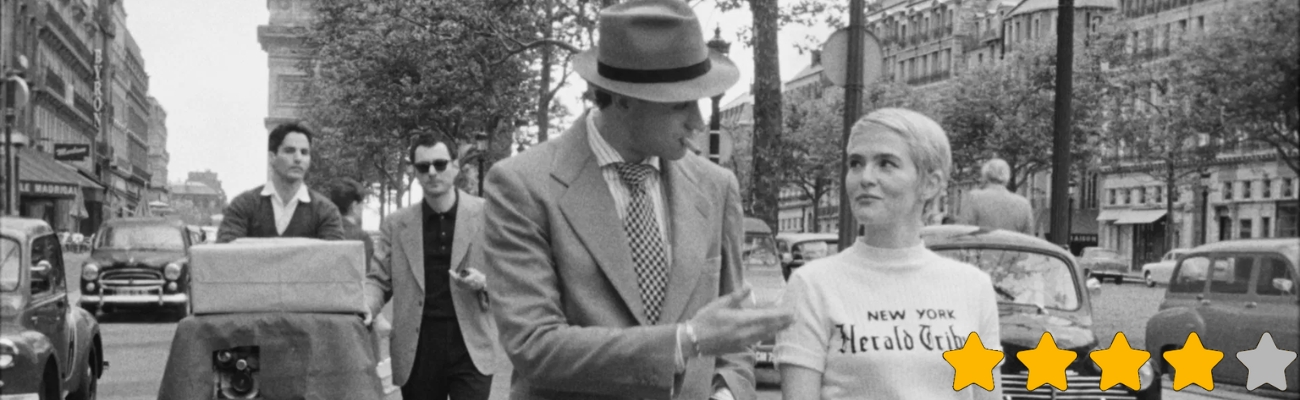
In fact, it is that exact situation where we first meet Godard (Guillaume Marbeck) as well as François Truffaut (Adrien Rouyard) and Claude Chabrol (Antoine Besson), in 1959 Paris when all three are film critics experiencing the latest outing by prominent producer Georges de Beauregard (Bruno Dreyfürst). Seeing his friends graduate to the realm of filmmakers themselves, with Truffaut about to debut The 400 Blows at Cannes, Godard resolves to do the same, and soon settles on a story inspired by a real-life petty criminal and his American girlfriend, casting his friend and then-unknown actor Jean-Paul Belmondo (Aubry Dullin) as the former, and starlet Jean Seberg (Zoey Deutch) as the latter. The majority of the film is dedicated to the process of Godard piecing together what would eventually become Breathless, his unorthodox filmmaking techniques – among them shooting just one or two takes at a time, feeding his actors lines he just came up with on the spot, and a blatant disregard for basic continuity – causing widespread confusion and frustration among the crew.
Obviously, the end result speaks for itself, but part of the fun that Nouvelle Vague gleefully emits comes from watching this guy push forward with his scattershot filmmaking, even if it means alienating everyone around him from cast to cameramen to producers, all of whom can’t make heads or tails of what this guy is on about. Half the time, you’re inclined to agree with everyone else since Godard, played with admirable magnetism by Marbeck, often comes off as the kind of condescending and pretentious prick you’d normally find in your class during first year of film school, always spouting pseudo-wisdom about the method of filmmaking while his sunglasses seem to be permanently stitched to his head, all in a manner that’s practically asking for him to be punched directly in the face. However, the film still manages to humanise him – at least, as much as you can with a famously prickly figure like Jean-Luc Godard – as you do see him forging bonds, however razor-thin, with his fellow crew members and other prominent names in the French New Wave like Agnès Varda and Éric Rohmer, all of whom are amusingly given their own introductory credit when they first appear.
The film could almost make a strong double feature with Tim Burton’s Ed Wood, not only because both are black-and-white biopics about eccentric directors making movies that nobody can quite understand, but also because Linklater, like Burton, clearly has such a high regard for his subject and his unique vision that he does incredibly well to recapture the general aesthetic of the French New Wave for his own homage to the guy. Shot in Academy ratioed monochrome, accompanied by a shot-on-film filter complete with occasional cue marks, Nouvelle Vague closely resembles a film from that era but with Linklater’s own personal touches, such as a hang-out vibe akin to something like Dazed and Confused as the cast and crew find themselves with plenty of free time on their hands thanks to Godard’s erratic guerilla filmmaking style, as well as funny moments where characters converse about the randomness of the production whilst in the middle of shooting actual scenes. Like Godard’s original masterpiece, the film has a nice zest of life to it that Linklater is able to replicate without feeling too postmodern or even critical of the process that would go on to inspire countless other filmmakers such as himself.
Sometimes, though, you do wish it were a bit more critical of its subject, because a few times the film seems too forgiving of Godard’s unpleasant behaviour for the power of his final product to land, and the film occasionally feels repetitive in how it depicts the rocky production from start to finish. But largely, the effect is plentiful and full of spark, as Nouvelle Vague serves as a cinematic love letter to one of the most influential filmmakers of all time as well as a fun, occasionally fascinating look at what went down at the birth of the French New Wave.
SO, TO SUM UP…
Nouvelle Vague is a sparky ode to the French New Wave and pioneering filmmaker Jean-Luc Godard, as director Richard Linklater lovingly recreates the amusingly uneven production and experimental aesthetic of his subject’s breakout film Breathless while remembering to humanise and pay tribute to the man himself.


Other recent reviews:

0 Comments