
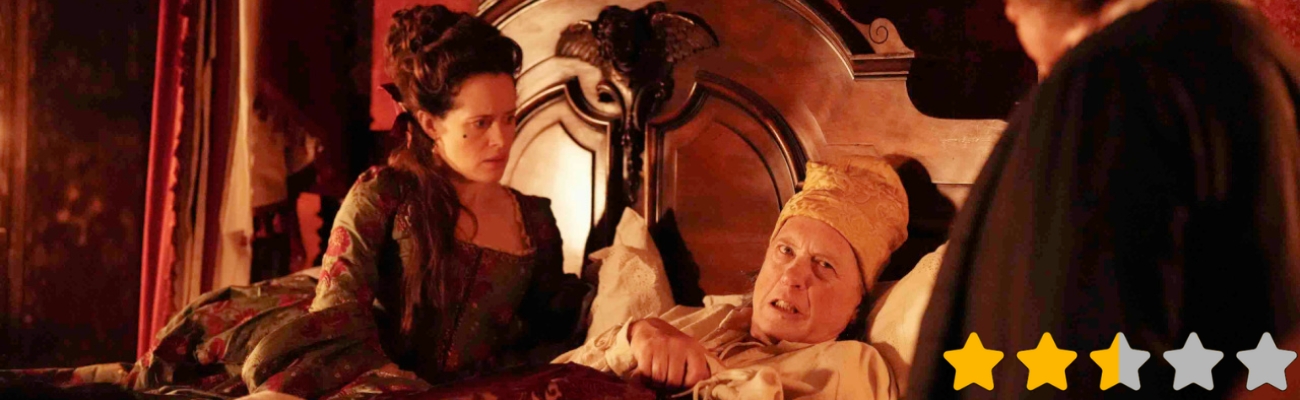
Savage House (dir. Peter Glanz)

Certificate: 15
Running Time: 114 mins
UK Distributor: Paramount Pictures
UK Release Date: 5 June 2026
WHO’S IN SAVAGE HOUSE?
Richard E. Grant, Claire Foy, Jack Farthing, Bel Powley, Kíla Lord Cassidy, Sebastian Armesto, Roger Ashton-Griffiths, Dominic Charman, Michael Culkin, Richard McCabe, Vicki Pepperdine, Pip Torrens, Tony Way, Nicholas Woodeson, Miles Jupp, Robert Bathurst
WHO’S BEHIND THE CAMERA?
Peter Glanz (director, writer, producer, editor), Mark Hopkins, Dylan Maranda, Oliver Roskill and Phillip Thomas (producers), Adriano Goldman (cinematographer)
WHAT’S IT ABOUT?
In 18th century England, an affluent couple (Grant and Foy) seek to improve their social standing…
WHAT ARE MY THOUGHTS ON SAVAGE HOUSE?
It may not be anyone’s immediate go-to when it comes to the filmography of Stanley Kubrick, but the filmmaker’s historical drama Barry Lyndon is an exceptional movie that should still be featured somewhere in any such conversation. Dryly humorous, emotionally complex, and as per anything to do with Kubrick beautifully made, the Georgian-era character study offered a distinct alternative and even cynical perspective of the period’s high society that the works of Jane Austen or even Bridgerton could never touch upon.
Kubrick’s film certainly seems to be a favourite of writer-director Peter Glanz, whose own costume drama Savage House feels particularly inspired by the aesthetic and narrative stylings of Barry Lyndon, right down to some of the same classical music cues and the use of a sardonic narrator to fill in certain plot details amidst all the intentionally colourless Georgian décor. However, Kubrick’s heavy influence ends up overshadowing the efforts of the film itself, which has moments of deliciously dark satire but largely succumbs to a faint feeling of redundancy.
Taking place in 18th century England, at a time when smallpox outbreaks are common and fears of Jacobite uprisings are even more so, our main players are Sir Chauncey (Richard E. Grant) and Lady Savage (Claire Foy), the owners of a vast country estate. Chauncey, a shameless social climber who married into his wife’s family for their money, has since left their legacy in ruins, his frivolous spending habits plunging the couple into debt and leaving them with only their similarly ghastly neighbours, the Bennetts (Richard McCabe and Vicki Pepperdine), to regularly socialise with. However, a chance to rectify their social standing arrives when they receive word from the Duke and Duchess of Devonshire, who both seek to visit and stay with the Savages for only a brief period, but long enough for Chauncey and his wife to gain the influence they need to stay afloat. So begins a hasty preparation period as the Savages and their handful of staff, including valet Reginald Halifax (Jack Farthing) and maid Dorothy (Bel Powley) – both of whom also serve as respective extramarital lovers for Lady Savage and Chauncey – rush to put on the perfect dinner party that could make or break them.
All in all, a perfectly fine set-up for a historical social satire. The issue, however, is that Glanz doesn’t quite seem able to stretch his script much further beyond the obvious points that it’s trying to make. Much like Barry Lyndon or The Favourite or even more contemporary films like Saltburn (also with Richard E. Grant), it’s a film that’s all about the lengths that people will go to in order to secure a better position for themselves, particularly within a society that values status over everything else, and Savage House doesn’t really have anything new to offer towards that particular discussion other than leaning further into how grotesque such lengths can be. But even then, Glanz plays it fairly safe as his characters aren’t that more unpleasant or absurd than the villains in a Roald Dahl book, while certain gross-out moments – including the uncouth disposal of a full chamber pot or a gaping wound becoming further gangrenous, and most of that is before a character is shown getting rimmed to completion by their lover – feel like they’re only there to add a bit of unearned shock value.
Flimsy script aside, with underdeveloped plot details and overly ambiguous character motivations on top of all the other flaws, Savage House remains watchable because not only does Glanz maintain a strong directorial grasp over his material – even if much of it borrows perhaps a bit too much from Barry Lyndon – but he also has two extremely capable leads who are more than game to surrender themselves to the depravity. Grant, in particular, is on fiery form as the wickedly pathetic Chauncey, in an all-too rare lead role that matches his endlessly appealing on-screen theatricality. He and Foy, the latter of whom is given slightly less to do but is no less sharp in her own comedic timing, are infectious in how devilish and scheming they can be, but with an ever so slight ounce of humility that comes out in their least secure moments. Glanz’s filmmaking reflects their made-for-each-other chemistry with a suitably grim and colourless environment where rotting fruit and unremarkable paintings more than noticeably symbolise the overall sense of ruin among this estate as well as its inhabitants.
Because of these riotous performances and how the director charts the rocky journey of his characters, there is a keen desire to see where things are going to go, although where it eventually ends up is more or less in line with how you may be thinking a film like this would end. That’s really the crux of the problem, for while it’s far from a bad film it just feels like you’ve seen it all before, largely because you have. Again, Barry Lyndon is very much on your mind while watching this movie, not just because its overall aesthetic is peculiarly close to Kubrick’s film, but also because it handles similar themes, messages, characters and even time periods in a much more refined and confident manner.
It’s the kind of film that Savage House so desperately wants to be, but lacks the sophistication, the intelligence, or even the wit to come anywhere close to matching it, and in trying too hard to be like something that it just isn’t, Glanz’s movie struggles to hold itself together beyond its admirable central performances.
SO, TO SUM UP…
Savage House is a historical satire that benefits from director Peter Glanz’s suitably dour directorial style and especially two extremely committed central turns by Richard E. Grant and Claire Foy, but a flimsy script that ends up not saying much that’s new as well as an aesthetic that’s perhaps too liberally borrowed from Stanley Kubrick’s far superior Georgian-era epic Barry Lyndon leaves it an amusing but redundant mixed bag.


Other recent reviews:



0 Comments