
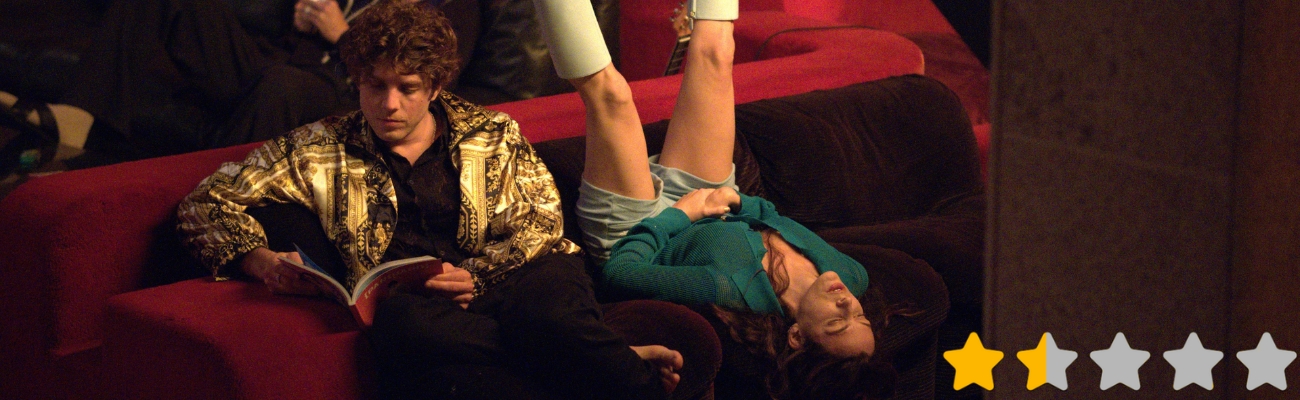
Rosebush Pruning (dir. Karim Aïnouz)

Certificate: 18
Running Time: 95 mins
UK Distributor: MUBI
UK Release Date: 10 July 2026
WHO’S IN ROSEBUSH PRUNING?
Jamie Bell, Callum Turner, Riley Keough, Lukas Gage, Elle Fanning, Tracy Letts, Pamela Anderson, Elena Anaya
WHO’S BEHIND THE CAMERA?
Karim Aïnouz (director), Efthimis Filippou (writer), Viola Fügen, Simone Gattoni, Michael Weber and Vladimir Zemtsov (producers), Matthew Herbert (composer), Hélène Louvart (cinematographer), Dávid Jancsó, Ilka Janka Nagy and Heike Parplies (editors)
WHAT’S IT ABOUT?
A wealthy family hides a disturbing truth…
WHAT ARE MY THOUGHTS ON ROSEBUSH PRUNING?
The world is not short on movies about how awful and vapid rich people are. These last few years, we’ve been overwhelmed with treasure troves of films like Parasite, Saltburn, Triangle of Sadness and The Menu, all and more of which have poked all the possible fun at the vast economic and class inequalities in our society, as well as how morally empty the lives of the ultra-wealthy actually are. And Rosebush Pruning, from director Karim Aïnouz and screenwriter Efthimis Filippou, is just another one of them.
Except, unlike most of those other examples of “eat the rich” cinema, Rosebush Pruning turns out to be just as vacuous and pompous as the very class of people it sets out to mock, and not in any kind of ironic self-aware sense either. Instead, it is a film that is so convinced of its own holier-than-thou stance that it fails to recognise how it’s actually just a bleaker-than-usual exploitation movie. But even then, it doesn’t work as not only is it not very entertaining, but the direction, writing, performances and cinematography are all so separated from one another that it’s hard to determine what exactly this movie is trying to get across.
A very loose reimagining of the 1965 Italian film Fists in the Pocket, the film focuses on an American family that has recently taken up residence in a secluded modernist villa in Catalonia. Among the adult siblings are Jack (Jamie Bell), Edward (Callum Turner), Anna (Riley Keough) and Robert (Lukas Gage), all of whom live in the villa with their blind father (Tracy Letts) and are still reeling from the apparent death of their mother (Pamela Anderson), who we’re told was ripped apart by a pack of wolves. Of the siblings, only Jack strives to lead a normal life, a fact that is made apparent when he introduces the family to his new girlfriend Martha (Elle Fanning), with whom he intends to eventually move in with and therefore away from the family itself. Of course, that doesn’t sit well with the family, who consider Jack to be the glue holding them all together – albeit in a rather warped sense, as it quickly becomes apparent – prompting Edward to ignite a plan that will see himself and his fellow family members be removed from the picture once and for all.
While the premise may suggest satirical foul play at every turn, the film itself never quite reaches a point where the satire becomes apparent. Filippou, who’s proven to be quite capable of bad-taste cinema thanks to his and Yorgos Lanthimos’s scripts for films like Dogtooth, The Lobster and Kinds of Kindness, only ever offers surface-level characterisation for a group of people whose self-absorption and entitled behaviour are only ever their most defining traits, and never digs deeper into any of them in order to find out what actually motivates them (if anything at all) or why they may behave so inappropriately. Because of that, none of them ever really feel like actual people that the viewer can comfortably laugh at, just exaggerated archetypes with disastrous social skills – a family lunch with Martha descends into severe discomfort when the conversation shifts towards the latter’s chest size – and a very icky attachment to one another that we eventually learn is more or less exactly what we think it is, which makes them feel so much thinner than the film perhaps thinks they are.
On that note, Rosebush Pruning is one of those films that simply wants to be shocking for the sake of shock value, but doesn’t really have anything else to offer other than the feeling of being provoked. On its own, the imagery of one character pleasuring themselves with an aubergine, another suggestively slicing their own leg to indulge someone else’s fetish for blood, and perhaps the most incestuous use of toothpaste in modern cinema, is certainly pushing all kinds of boundaries, but Aïnouz’s direction rarely finds purpose behind such moments and simply presents them without much trace of irony or even dark humour. Mostly, it’s just kind of off-putting and even gross, but it is so convinced with its arthouse cinematography and wistful writing that what it’s showing is deep and meaningful that the tongue-in-cheek exploitation aspect of it all is no longer fun to watch.
Perhaps stranger is the disconnect between the creatives and their actors, all of whom feel as though they’re making entirely different films from one another. Callum Turner, for instance, seems convinced he’s in some kind of noir-ish thriller where he’s some kind of Tom Ripley character who fancies himself a manipulator and, in one of the film’s weirder plot points, a master imitator of voices. Meanwhile, Riley Keough appears to be wallowing through a quirky Sofia Coppola melodrama, Lukas Gage sometimes behaves like he’s out of a Farrelly Brothers comedy (and given how gullible he is a lot of the time when it comes to deadly later events, he might as well be in one of those movies), and while both Jamie Bell and Elle Fanning are perhaps the ones who come closest to the intended tone, their dynamic comes with random developments that are either vague or don’t really make much sense.
It is at least a visually interesting movie, and you can tell that Aïnouz, Filippou and their ensemble clearly wanted to make a good movie, but Rosebush Pruning just hasn’t turned out that way, for it comes off as pretentious, vapid and unpleasant when it thinks it’s the defining film in this whole “eat the rich” category of films. Instead, it’ll make you want to throw up from eating all that richness.
SO, TO SUM UP…
Rosebush Pruning is a hollow attempt to satire wealthy family lifestyles that buckles under the weight of its own pretension and overly provocative shock value, with a stark disconnect between the creatives and the actors over what kind of film they’re making also rendering it somewhat directionless.



Other recent reviews:







0 Comments