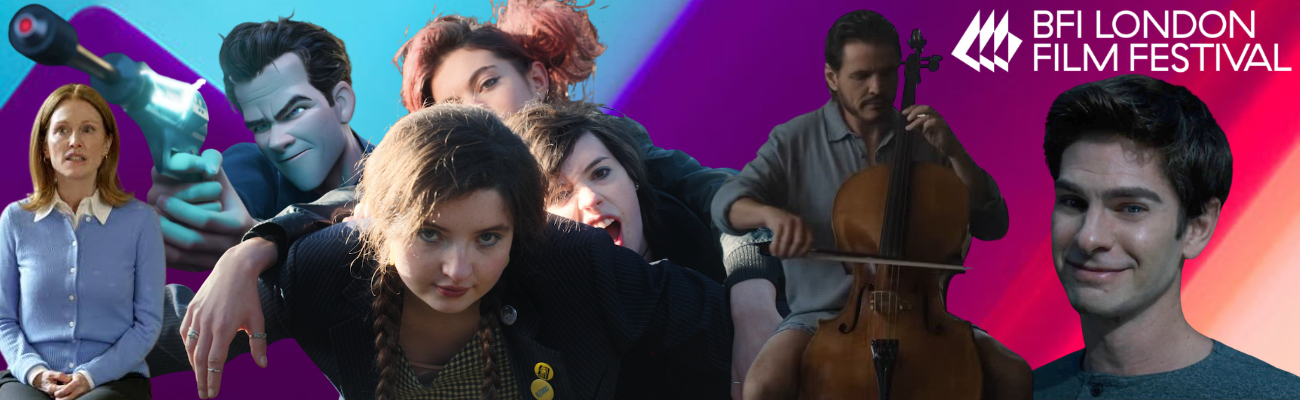
BFI London Film Festival 2026 Reviews: The Debut, Ray Gunn and more!
Apologies for the lateness (basically, life’s been life-ing), but here is the final bunch of reviews from this year’s BFI London Film Festival!
You can use the hyperlinks below to skip to the review of your choice, though obviously we highly recommend reading every single one (that way, our writing won’t entirely go to waste)!
Ray Gunn (dir. Brad Bird)
Click To Read Our Review For Ray Gunn!
WHO’S IN RAY GUNN?
Sam Rockwell, Scarlett Johansson, Tom Waits, Matt Berry, Bobby Cannavale, Alan Tudyk, Michael Chernus, Patton Oswalt, Brad Bird, Kathryn Hunter, John Ratzenberger, Jamie Costa, Kether Donohue, Michelle Rodriguez, Aasif Mandvi, Matt Jones, Justin Peck
WHO’S BEHIND THE CAMERA?
Brad Bird (director, writer, producer), Matthew Robbins (writer), Lisa Beroud, David Ellison, Dana Goldberg and John Lasseter (producers), Michael Giacchino (composer), Erik Smitt (cinematographer), Karl Armstrong and Darren T. Holmes (editors)
WHAT’S IT ABOUT?
A detective (Rockwell) living in a retro sci-fi future is drawn into a complex mystery…
WHAT ARE MY THOUGHTS ON RAY GUNN?
As a creative, there is no greater feeling than to finally get the idea you’ve been bubbling up inside your mind out into the wider world, regardless of whether or not the wider world actually likes it. Brad Bird must surely be experiencing that feeling now that he’s been able at long last to make and release Ray Gunn, a project that he’s had in development as far back as the 1990s (it was originally due to be made at Warner Bros, until the studio’s notoriously handling of publicity for Bird’s debut feature The Iron Giant) and has now come to fruition under the John Lasseter-headed Skydance Animation.
It’s a healthy plus that the movie has turned out to be a good bit of fun (despite, y’know, the Lasseter and Skydance of it all), as it blends two distinct genres together for a unique and visually energetic ride that pays loving tribute to both of them and also brings out the best of Bird, but also some of his slightly more convoluted tendencies which prevent it from being his true masterpiece.
The film takes place in the retro-futuristic city of Metropia, where humans and aliens live among each other amid giant art-deco inspired buildings and sci-fi weaponry. Operating in this city is the titular Ray Gunn (voiced by Sam Rockwell), one of the only remaining human detectives who, along with his alien cyclops partner-in-crime Eye-Ra (Tom Waits), makes a meagre living by undertaking some private investigative work among the city’s elites, who’d rather hire more practical and thus cheaper extraterrestrial sleuths. Soon, he’s assigned to keep an eye on the popular but famously troubled pop star Venus Nova (Scarlett Johansson) before she creates yet another headache-inducing publicity scandal, but things become more intense when a bunch of murders start happening, drawing Ray further into a conspiracy where nothing is as it seems.
Bird’s vision of this world is essentially a mix of classic detective film noir and pulpy science-fiction, like if someone set The Maltese Falcon in the universe of Star Wars, and there’s a lot that the filmmaker does to make this blended environment thrive with creative splendour. Flying cars, jet packs, black-and-white holograms, guns that can contain and then release targets like they’re Poké Balls, and alien eyes being used as cameras are just some of the amusing things in this world that play neatly into the sci-fi aspect, as do the numerous alien creatures who make up various supporting roles or even just extras roaming about in the background. Bird utilises all these elements whenever possible to create a series of exciting set-pieces that embrace the limitless potential of the genre, while also from time to time going into some unexpectedly horrifying, even hilariously Cronenbergian territory.
The filmmaker is clearly far more enamoured with the film noir aspects of his and Matthew Robbins’ script, and he does very well to not only replicate certain characteristics from classic examples of that genre, but to also create a rather compelling example of his very own. The central mystery unfolds like a classic Raymond Chandler story with murders and conspiracies aplenty, with Michael Giacchino’s jazzy score underlining the grittiness of the plot but also the liveliness of its sci-fi fusions. While parts of this mystery are almost insultingly easy to deduce long before the title character does, the way in which it unfolds still makes you curious as to how the inevitable conclusions will come about, because Bird’s direction and writing is full of that bouncy and fast-paced energy from his previous works which makes it all go by at a smooth pace. However, the plotting can also find itself in all kinds of knots, a problem that also became apparent in the filmmaker’s previous movie Incredibles 2, and here there are points where you’ll struggle to understand the motivations of certain players as well as what exactly they’re trying to accomplish.
But luckily, Bird’s enthusiasm for the genre and the environment he’s created overcomes those convolutions, and that passion seeps into the very person whom his film is named after. The character of Ray Gunn is very much the kind of jaded yet vaguely optimistic sleuth that the likes of Humphrey Bogart could have played in his sleep, and the way he’s written as well as how Rockwell voices him makes this protagonist feel lifted directly from that era, as his smooth and laid-back vocals delivering the sardonically witty dialogue with that sly, ever so slightly smug tone of classic film noir leads. But in Bird’s hands, the character is given an extra dimension of humanity, for Ray Gunn someone who is adamant about always doing the right thing, to where he turns down big paydays over the questionable morals behind them (much to Eye-Ra’s ire, as he’d rather they have the money to keep their business afloat), which makes him likeable but also vulnerable, especially when it comes to his relationship with Johansson’s Venus Nova.
That central dynamic also takes heavy cues from the romantic angles of old film noir cinema, with Rockwell and Johansson trading barbs with one another at a rhythmic back-and-forth speed, almost eerily like the classic pairing of Bogart and Lauren Bacall in films like The Big Sleep. The actors’ chemistry shines through their vocals, but also in how the animated characters are (no pun intended) drawn to one another as interesting, complex people with as much sultriness and vigour as their live-action counterparts. In Venus’s case, the film appears to position her in more of a femme fatale role at times, but Bird is of course too smart a filmmaker to just have a character as well-rounded as this be stuck in that limiting and quite outdated archetype, which also comes from Johansson’s own extremely enthusiastic vocal performance.
In all, Ray Gunn is as much fun as anything Bird has been involved with in the past, though here it’s really cool to see him indulge in other unexpected types of filmic storytelling for a love letter to genres that end up complimenting each other so well that it’s almost baffling how he wasn’t able to bring them together before. To bring in an overused pun, I wouldn’t say it’s completely out of this world, but it rises high enough to at least reach the stratosphere.
SO, TO SUM UP…
Ray Gunn is a passionate blend of classic film noir and pulpy sci-fi by filmmaker Brad Bird that makes for a fun and inventive genre mash-up, one that boasts the director’s zippy energy and high inventiveness within a compelling if slightly convoluted story and set of likeable and complex characters who are perfectly cut from that film noir cloth.
⭐⭐⭐⭐
Artificial (dir. Luca Guadagnino)
Click To Read Our Review For Artificial!
WHO’S IN ARTIFICIAL?
Andrew Garfield, Yura Borisov, Monica Barbaro, Cooper Hoffman, Jason Schwartzman, Chris O’Dowd, Ike Barinholtz, Mark Rylance, Zosia Mamet, Cooper Koch, Billie Lourd, Angus Imrie, Nicholas Hamilton, Thaddea Graham, Will Angus, Will Price
WHO’S BEHIND THE CAMERA?
Luca Guadagnino (director, producer), Simon Rich (writer, producer), Jeffrey Clifford, Jennifer Fox and David Heyman (producers), Damon Albarn (composer), Malik Hassan Sayeed (cinematographer), Marco Costa (editor)
WHAT’S IT ABOUT?
The story of OpenAI and the people behind it, including a certain Sam Altman (Garfield)…
WHAT ARE MY THOUGHTS ON ARTIFICIAL?
As terrifying as it may be to admit, AI is here to stay. What was once a piece of science-fiction has rapidly become science-fact, as more and more institutions are adopting sophisticated AI technologies to develop knowledge and resources far beyond our human understanding, with the hopes that it can create a better and safer world. But within the creative realm, there is serious division as to the level of which artificial intelligence can and should be used to make art, with the vast majority (myself included) agreeing that it should be coming exclusively from the human brain rather than a machine without as much emotional capability. Besides, among many other ethical issues, relying on AI to make art runs the risk of numerous plagiarism lawsuits, since it’s basically deriving from established information and other works by actual artists.
However, in director Luca Guadagnino’s unsettling drama Artificial, it’s revealed that when it comes to AI, or at least the people behind it, there is a rather scary precedent being set that seems destined to forcefully negate that division, ultimately in their favour. That alone is more frightening than anything else within that AI conversation, and the film packs serious punch into its real-life cautionary tale which offers a stark warning about where it’s all eventually headed, even if it’s sometimes hard to understand or even connect with what that warning is.
The film is a chronological presentation of how the company known the world over as OpenAI – aka the owner and creator of ChatGPT – came to be a titan player in the AI industry. Beginning in 2003, we first meet 17-year-old Ilya Sutskever (Yura Borisov) as he collaborates with his university professor Geoffrey Hinton (Mark Rylance) to develop an AI model that is eventually sold to Google, which doesn’t really know what to do with it. Then, along comes a swaggering Silicon Valley stud by the name of Sam Altman (Andrew Garfield), who poaches Ilya into joining a select group of what are essentially tech bros – including the one and only Elon Musk (Ike Barinholtz) – to develop the algorithm into something that can harness the power to think for itself, possibly at even greater speeds than the human mind. It’s around the point when it looks as though their product could well and truly evolve into Artificial General Intelligence – aka some real Skynet or HAL 9000 type stuff – that Ilya begins having some moral doubts about what he is helping to potentially unleash upon the world, and more concerningly who he’s unleashing it with.
Those who know about the whole Sam Altman drama that unfolded just a few years ago will no doubt be expecting that to play into the film’s events, and it does much later on, but Artificial is about much more than just that rollercoaster days-long chapter in OpenAI’s recent history. In fact, while Garfield’s hauntingly sociopathic turn as Altman is bound to receive the lion’s share of attention from most viewers – and rightly so, as it’s one of his finest performances – Altman isn’t even the protagonist here. He’s merely a supporting role in an ensemble of characters created by screenwriter Simon Rich to represent the kind of people who perhaps shouldn’t have as much unrestricted access to a tool that has the potential to do more harm than good, even those such as Sutskever (whom Borisov imbues with as much grounded humility as his Oscar-nominated turn in Anora) who becomes so consumed by the clout that such a tool can bring that his good intentions become mere background fodder.
The whole film is essentially a fusion of The Social Network and The Wolf of Wall Street, its “geek shall inherit the earth” mentality crossed with the frat-boy energy of douchebags who favour infamy over sensibility or even integrity, as the likes of Altman, Musk and (to a slightly more reluctant extent) Sutskever approach their act of playing God as though it were a booze-soaked hazing ritual. Guadagnino brings his frivolous style to scenes that interestingly make it feel as though the movie is sometimes glitching, like we’re in some ChatGPT-generated reality where it’s becoming increasingly hard to tell what’s real and what’s emerged straight from the AI uncanny valley. It’s an unnerving thought that makes the film much more sinister, especially if you’re watching it in a somewhat lucid dream state where it feels like some kind of surrealist nightmare you can’t seem to wake up from.
But while the film is effective in its disturbing approach to the powers behind this concerning piece of technology, it is a very dense script that those without excessive knowledge of AI algorithms and computing jargon may struggle to keep up with. It’s respectable that Rich refuses to dumb down any of his dialogue or make it more accessible as Adam McKay did with stock talk in The Big Short, but that risks alienating general audiences who may know only the basics but not as many of the actual details of this sector and its most prominent figureheads. It can feel a little emotionally cold as a result, with few characters making that much of an impression – some, like Monica Barbaro as Open AI’s chief technology officer Mira Murati, barely even register as characters – while the ones that do keep their true intentions and feelings so closed off that it becomes tricky to truly decipher them.
Again, that could all be by design, given how uncomfortably soulless AI is (at least, for now), but a film like Artificial which intends to expose not just the dangerous implications of unregulated AI but also the categorically sinister people in charge of it all needs something of a soul for viewers to latch onto. Therefore, it’s a pretty good film that’s ever so shy of being great, but regardless has a distinct approach and mindset that cannot be generated by any machine.
SO, TO SUM UP…
Artificial is a chilling exploration of how AI and especially the company and people behind ChatGPT became as big as they now are but may also cause humanity’s ultimate downfall, which would be as effective as Luca Guadagnino’s feverish direction and Andrew Garfield’s haunting turn as Sam Altman if it weren’t for an overly dense and somewhat cold script.
⭐⭐⭐½
Behemoth! (dir. Tony Gilroy)
Click To Read Our Review For Behemoth!
WHO’S IN BEHEMOTH!?
Pedro Pascal, Olivia Wilde, Eva Victor, Will Arnett, Hank Azaria, Alexa Swinton, Kaya Ralls, Erik Griffin, JoBeth Williams, Margarita Leviera, Matthew Lillard, Barry Livingston, Adam Rose
WHO’S BEHIND THE CAMERA?
Tony Gilroy (director, writer, producer), John Gilroy (producer, editor), Sanne Wohlenberg (producer), Michael Abels, Emily Bear, Lukas Frank, Michael Giacchino, James Newton Howard, Henry Jackman, Nami Melumad, Brandon Roberts and Alan Silvestri (composers), Damián García (cinematographer)
WHAT’S IT ABOUT?
A celebrated cellist (Pascal) returns to Los Angeles to record a movie soundtrack…
WHAT ARE MY THOUGHTS ON BEHEMOTH!?
It should go without saying, but I’ll say it anyway: one of the most important components of any movie is its soundtrack. Even when the movie itself isn’t all that great, a musical score can do a lot of heavy lifting as it leads the viewer toward exactly what kind of feelings they’re meant to be experiencing, and over the decades composers like John Williams, Thomas Newman, Alexandre Desplat and Rachel Portman have earned some of their films’ highest praise for pieces that have stood out for their emotional complexity and their staggering beauty.
But then you have a film like Tony Gilroy’s Behemoth!, which is so unsure of how it wants its audience to feel throughout its own narrative that it enlists not one, not two, not even five, but NINE different composers to create even just a mere idea of how to react. Singularly credited as “The Behemoth! Collective”, the composers (all listed above) have been tasked with providing numerous distinct musical cues that ultimately create a varied and eclectic atmosphere from which the viewer can then decide how to emotionally respond, in a radical cinematic experiment that highlights the importance of music in movies.
However, not even the combined musical efforts of this collective can truly save this rather frustrating movie that you so desperately want to admire, even if it’s just from an idealistic standpoint, but can’t because it’s far too meandering and unfocused in order for it to truly work.
I’ll be honest, Behemoth! is a very difficult film to describe the synopsis of. Not because it’s filled with spoilers or anything (though frankly, even if I wanted to there’s very little here to actually spoil), but beyond the basics it’s extremely light on actual plot. Said basics are that Alex Serian (Pedro Pascal) is a revered cellist who, after an extended period of performing in orchestras across the world, returns to Los Angeles where he takes up a few gigs as a session musician for the recording of a new film score. Much of the movie, however, is made up of noticeably unstructured flashbacks showing aspects of his family history, including his late musician father Peter (Hank Azaria) and his relationship with his brother Andy (Will Arnett), as well as his past flings, most notably with fellow music prodigy Nadia (Eva Victor) and wealthy, unusually persistent arts patron Carol (Olivia Wilde).
The film darts around so much from one point in time to the next, even when things are taking place in the film’s present, that it’s hard to know what exactly is happening, and in which order. One moment, Alex is settling into a comfortable relationship with another woman, and then the next, we’re suddenly a few years ahead when their partner is not only now dead but has also in that time birthed a child (whose parentage forms one of the only identifiable plot points in the entire movie). Gilroy’s script takes a strangely fragmented approach that always keeps the viewer at an emotional distance from the main character and his journey to where, by the film’s midpoint, you still feel as though you barely know anything about this guy or who he is beyond his musical gifts and his philandering nature. In terms of Pascal’s lead roles in movies this year, you feel as though you know more about him as The Mandalorian than you do him as Alex Serian (though in fairness, that other role of his had at least three seasons of a TV show to establish his character), because while the actor relies heavily on his natural on-screen charisma, he’s saddled with a stagnant and undefinable lead role that is nearly impossible to figure out until the final few moments.
By then, it’s too late to get invested because the fundamental lack of narrative structure and emotional disconnect has made Behemoth! a rather cold movie to get through. It is saved, funnily enough, by the literal bell; that, of course, being the musical score provided by The Behemoth! Collective which is cleverly interspersed across various sequences to create distinct tones all throughout. A late scene involving a character sneaking into a person’s home to gather certain evidence is scored like a thrilling chase movie; a much earlier one where Alex attempts to avoid a heated confrontation carries the tune of a grand classical piece straight out of Fantasia; and one brief scene is scored like a slapstick comedy, complete with cartoonish sound effects. Gilroy gives his various composers a wide and expansive platform for which to create an auditory cinematic experience that anchors the otherwise scatterbrained source material.
Again, you want to get behind this movie, as it is thinking outside of the box in how to create an emotional narrative that is free from the traditional three-act and relies on other senses than just the eyes to tell it, which rarely happens in most major studio-backed movies, let alone ones that are being primed for awards season. Unfortunately, Behemoth! is so emotionally distant and frustratingly vague when it comes to character and plot that not even an inspired use of its soundtrack can give it the emotional centre that it so desperately needs, and it ends up falling on far too many bum notes for this experiment to produce the desired results.
Still, I bet the soundtrack for this movie is going to be heavily streamed by film score enthusiasts on Spotify after this movie comes out, which will at least give it something to fall back on.
SO, TO SUM UP…
Behemoth! is a radical but ultimately failed cinematic experiment revolving around a precise and cleverly deployed soundtrack, but the fragmented narrative structure prevents an emotional centre from forming, making this a cold viewing experience beyond its high musical ambitions.
⭐⭐½
7 Miles Out (dir. Carol Morley)
Click To Read Our Review For 7 Miles Out!
WHO’S IN 7 MILES OUT?
Lucy Halliday, Aidan Gillen, Gemma Whelan, Leila Entwistle, Kasper Hilton-Hille, Hannah McIver, Clare Grogan, Elizabeth Meadows, Daisy-Mai Foden, Gracie Darlington, Jim English, Amelie Hughes
WHO’S BEHIND THE CAMERA?
Carol Morley (director, writer), Cairo Cannon (producer), Carly Paradis (composer), Agnès Godard (cinematographer), Raluca Petre (editor)
WHAT’S IT ABOUT?
In 1970s Manchester, a teenage girl (Halliday) overcomes grief through the local music scene…
WHAT ARE MY THOUGHTS ON 7 MILES OUT?
If you look up filmmaker Carol Morley’s page on Rotten Tomatoes, you’ll find that although many of her films have gained strong critical reception, most if not all of them have alarmingly low audience scores. For instance, her previous feature Typist Artist Pirate King is as of writing her highest-rated film with a Tomatometer of 94%, but the general public is far more split with a 50% Popcornmeter rating. That’s not even to mention The Falling, which helped put her (and its then-unknown star Florence Pugh) on the map, yet currently sits at a comfortable 78% critics score but a 35% audience ranking.
The consensus seems to be that Morley’s vividly idiosyncratic approach isn’t for everyone, but you could say that about any visionary filmmaker out there, even the ones that are more universally adored like Stanley Kubrick or even Christopher Nolan. Morley, however, is one filmmaker whose oddball filmography was never meant to please everyone, as she is first and foremost an artist who admirably refuses to be boxed into conventional practice, structuring and framing even the most straightforward dramatic scene with a strange, otherworldly touch that arguably makes it stand out more than with other filmmakers, for its eccentricity alone.
Morley certainly pours a lot of herself into each and every one of her movies, but perhaps none more so than in 7 Miles Out, a coming-of-age drama based on her own semi-autobiographical novel of the same name, and thus sees the filmmaker tap into more personal areas than before to show viewers a fictionalised, and very Morley-ified, origin of where her distinct vision came from.
The film takes place during the 70s, beginning as young Morley surrogate Ann Westbourne (Amelie Hughes) lives with her family – including her mother Bryn (Gemma Whelan), her older wannabe music journalist brother Scott (Kasper Hilton-Hille), and her father Ronald (Aidan Gillen) whom she worships despite his cold, clearly troubled demeanour – in Stockport, which is roughly the titular distance from the city of Manchester. However, it is a tragic loss among the family that begins to haunt Ann as she grows into adolescence (and suddenly resembles California Schemin’ and The Testaments star Lucy Halliday) and finds various outlets, chief among them starting a band with her best friend Hel (Leila Entwistle) like their music heroes Joy Division, to try and mask her emotional pain.
The journey, as often is the case with most teens, is messy and mixed with highs and lows of varying stakes, from struggling to afford the money for tickets to a gig with their idols, to dealing with family members who have developed some severe mental illness in their unwavering grief. Morley’s characteristically odd approach gives such scenes an unpredictable flow, like one conversation between mother and daughter which goes on a fascinating emotional journey from jovial and reminiscent one moment to angry and borderline abusive the next. Another pivotal moment features a surprise encounter with a particular key figure from the Manchester music scene, right in the middle of a heated argument at the front door of aforementioned gig. All the while, the filmmaker manages to keep things going at a steady pace where major events can happen so suddenly but with enough of a fascinating jolt of energy to make it all work within the idiosyncrasies of the world that she is presenting.
Of course, 7 Miles Out is considerably more grounded in nature than Typist Artist Pirate King or even The Falling, but Morley remains unwavering in her soothing, almost hypnotically strange vision even as her on-screen surrogate’s world begins to come crashing all the way down. A number of colourful, if thinly sketched, supporting characters, from the other few occupants living alongside the protagonist and her mother in the halfway house they now occupy, to a band of almost robotically mean bullies who always seem to exist in tandem with one another since they’re rarely apart (if ever), fuel the script’s warped vision as they come and go like extras in a Monty Python sketch, in a story which is thoroughly concerned with young Ann’s development (or lack thereof, in some regards) as she processes grief through the lens of her local culture.
And yet, these two polar opposites end up vastly complimenting each other, as Morley reconfigures the emotional centre around a lead character who you can relate to (at least, up to a point) as she unevenly gravitates towards adulthood with the weight of her trauma keeping her from fully taking flight. Ann, largely played by an outstanding Halliday, reflects the filmmaker’s own messiness through an arc that can largely be seen as waffly or even stagnant, but is powerful in what’s not being outwardly said, especially as she deals with the mental strain and insecurities inherited from her family genes, and as she drifts from one source of comfort to another she forms a distinct, uncertain personality that could be interpreted as a thinly-veiled version of Morley herself: fierce, outspoken, just a little bit doolally, and always fascinating to watch in action.
In all, I found 7 Miles Out to be a fascinating self-portrait of a filmmaker whose singular artistically style is the result of a lifetime of confusion and uncertainty, which she conveys with as much eccentric free-spiritedness as anything else she’s ever done.
SO, TO SUM UP…
7 Miles Out is a fascinating semi-autobiographical take on writer-director Carol Morley’s rocky journey through adolescence, with its absorbing bouts with grief and cultural comforts being constantly complimented by the filmmaker’s signature idiosyncratic approach to the craft.
⭐⭐⭐⭐
The Debut (dir. Jesse Eisenberg)
Click To Read Our Review For The Debut!
WHO’S IN THE DEBUT?
Julianne Moore, Paul Giamatti, Halle Bailey, Colton Ryan, Jesse Eisenberg, Bonnie Milligan, Lilli Cooper, Maulik Pancholy, Bernadette Peters, Cara Buono, Havana Rose Liu, Eldar Isgandarov, Patrick Fabian, K. Todd Freeman, Craig Bierko, Danny Burstein, Susan Blommaert, Stephen Adly Guirgis, Jonah Diamand, Becca Suskauer, Danny McCarthy, Ana Yi Puig, Christopher Fitzgerald, Andy Grotelueschen, Nikka Graff Lanzarone
WHO’S BEHIND THE CAMERA?
Jesse Eisenberg (director, writer, producer, composer), Ali Herting, Dave McCary and Emma Stone (producers), Emile Mosseri (composer), Drew Daniels (cinematographer), Robert Nassau (editor)
WHAT’S IT ABOUT?
A put-upon housewife (Moore) auditions for a local community theatre…
WHAT ARE MY THOUGHTS ON THE DEBUT?
For an actor, the idea of losing oneself completely in the character they’ve been tasked with bringing to life can be mentally and sometimes even physically taxing, but if writer-director Jesse Eisenberg’s The Debut proves anything, it’s how that mentality can also be absolutely hilarious.
Perhaps not so much for method actors, who takes their craft much more seriously. But these heavily immersive practises of theirs have created a sharp division among the acting community, and indeed the industry as a whole. It is understandable if an actor like, say, Daniel Day-Lewis or Robert De Niro needs to fully integrate into a role to deliver the sharpest and most naturalistic performance possible, but then there are others – some of whom shall remain nameless, but I’m pretty sure you already know who I’m referring to – who basically use the term as an excuse to just behave like a complete jackass on or around the set. Sending your co-stars weird stuff like used condoms or live rats, or not bathing for days on end, or even just starving yourself until you’re at an impossibly thin weight, all of which can apparently be easily forgiven if the offending party slaps the term “method acting” onto all of it, providing them with a much-needed get-out-of-jail-free card to continue being so unbearable.
It’s these kinds of actors whom Eisenberg seems to be poking heavy fun at, in a hugely enjoyable and very funny film that celebrates the liberating art of performance while also taking aim at those who take their passion way, way too far.
Our unlikely methodist – not the religion, though in a way method acting kind of is one – is Mona Friedman (Julianne Moore), a shy and otherwise unassuming New Jersey housewife who impulsively auditions for a supporting role in the local community theatre production of a musical called Nosy Neighbors. Her stagnant delivery and lack of confidence initially doesn’t impress the show’s director Jerry Blankenbuehler (Paul Giamatti), but soon she gets the call to play the part when Jerry’s intended actor pulls out, mainly because Mona was the only other one who auditioned for the part of Miss Danielle, the superintendent of the apartment building where all the main characters live. Under Jerry’s guidance, Mona begins to find the actor inside her and uses her newfound performing skills to bring out her own interpretation of Miss Danielle… which, as you may have already guessed, means that she begins living and breathing the part, to where she begins clashing with her own director about what kind of role she is meant to be playing.
Operating on a far more comedic scale than his previous film, the more sombre comedy-drama A Real Pain, Eisenberg embraces an infectious type of theatre kid mentality as the company welcomes novice Mona with open arms, which quickly gives way to a surprisingly surreal descent into the madness that comes with full-time performing. The filmmaker creates a lively atmosphere as fellow actors, stagehands and costume handlers strut across the auditorium and behind the curtains, which for anyone who’s ever been involved in any kind of stage production whether it’s in school or your own community troupe will undoubtedly be a delightful thing to watch unfold on the screen. But then, as Mona becomes more and more consumed with actually becoming Miss Danielle as opposed to just playing her, he also unleashes a humorous psychological battle of wits as Mona takes her newfound passion way too far, to where she even checks herself into a dingy hotel just to get a feel of the kind of building her character is meant to be in charge of.
As a filmmaker, Eisenberg has a wonderful knack for farcical comedy that can be witty and crowd-pleasing one moment, and then cerebral and rather unhinged the next, all of which come at once as he satirises the method approach and how extreme some performers can take it. Not his performers, though, for Julianne Moore is absolutely brilliant in a role that sees her undergo a major metamorphosis to increasingly hilarious heights, and she has never been not only funnier but also more poignant as she slowly discovers the life she was perhaps meant to lead rather than the stagnant one she’s been stuck in. Paul Giamatti is very much her equal, his Jerry flirting between stern yet compassionate visionary and complicit enabler (in one scene, he encourages her to pose as a superintendent in an actual apartment building as a training exercise), but he always emits a warm presence that one can’t help but be sucked into. Both leads are fantastic together, delivering back-and-forths in certain scenes that will no doubt inspire many viewers to spontaneously applause at their crescendoes, like watching a fiercely performed stage production in and of itself.
The ways in which The Debut tears apart the method approach deserve to be seen with fresh eyes, but trust me when I say it’s a hell of a deconstruction, one that Eisenberg puts his unique filmmaking skills into for something that is funny, profound, abstract, and most importantly adoring of the purity within the very nature of performance, one that not even the most unpleasant of method actors can ever truly erase.
SO, TO SUM UP…
The Debut is a hilarious but also profound celebration of performance as well as a farcical deconstruction of the method acting mindset, which filmmaker Jesse Eisenberg enlivens with sharp writing and direction, as well as two fantastic lead turns by Julianne Moore and Paul Giamatti.
⭐⭐⭐⭐½
That’s about it for this year’s edition of the BFI London Film Festival – be sure to come back next year for a whole new set of anticipated movies to work up an appetite for!

Other recent reviews:




0 Comments