Fjord (dir. Cristian Mungiu)

Certificate: 15
Running Time: 146 mins
UK Distributor: Picturehouse Entertainment
UK Release Date: 13 November 2026
WHO’S IN FJORD?
Sebastian Stan, Renate Reinsve, Lisa Carlehed, Henrikke Lund-Olsen, Vanessa Ceban, Jonathan Ciprian Breazu, Ellen Dorrit Petersen, Lisa Loven Kongsli, Markus Tønseth
WHO’S BEHIND THE CAMERA?
Cristian Mungiu (director, writer, producer), Kristina Börjeson, Pascal Caucheteux, Adela Vrânceanu Celibidache, Dyveke Bjørkly Graver, Emilia Haukka, Mikkel Jersin, Vincent Maraval, Andrea Berentsen Ottmar, Marco Perego, Katrin Pors, Jussi Rantamäki, Grégoire Sorlat, Mimmi Spång and Sean Wheelan (producers), Kaspar Kaae (composer), Tudor Vladimir Panduru (cinematographer), Mircea Olteanu (editor)
WHAT’S IT ABOUT?
A conservative Romanian family moves to a progressive community in Norway…
WHAT ARE MY THOUGHTS ON FJORD?
In an age where conservatism and liberalism are more at each other’s throats than ever, to “both-sides” a hotly debated issue is seen either as an act of cowardice, or an indirect enablement of allowing more immoral mindsets the benefit of the doubt. Sometimes, though, a both-sides approach can help us to understand a wholly different set of opinions other than our own, and even if you still disagree after hearing them, at least you’ll know better as to why they think differently to you rather than just dismissing them from the offset.
Fjord, the latest film from Romanian filmmaker Cristian Mungiu, is an interesting filmic example of how a both-sides approach can make a seemingly straightforward issue more complex than it seems on the surface. By neither condemning nor condoning either side, Mungiu allows himself to show the pros and cons of the central conflict as well as how much of a messy situation it truly is for all involved.
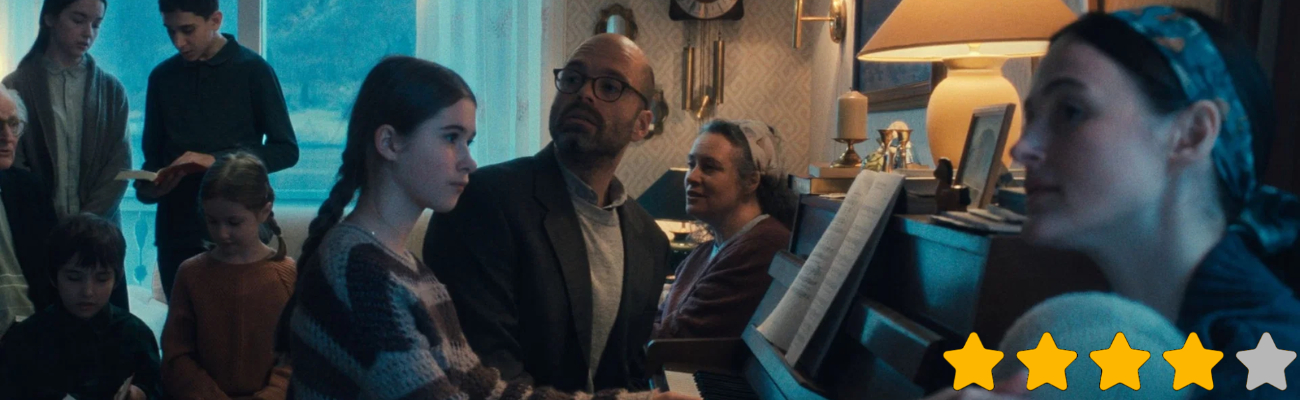
In the film, we meet Romanian engineer Mihai (Sebastian Stan) and his nurse wife Lisbet (Renate Reinsve) shortly after they have moved to a quaint little community in her native Norway with their five young children. Theirs is a fiercely devout household, strict in its conservative evangelical doctrine which impacts on the way they impose severe limitations on their kids, which puts them at odds with their much more progressive neighbours who, in their somewhat self-satisfied way, attempt to turn the other cheek.
But things heat up when one of the children’s teachers notices bruises over their body, leading them to notify Child Services who remove the kids from Mihai and Lisbet’s care pending a full criminal investigation into their suspected abuse, which they deny aside from the occasional spanking which they insist is never intended to cause harm. With their attorney neighbour Mia (Lisa Carlehed) representing them in court, the parents use whatever avenue they can to regain custody and prove to not just the legal system but also those in their community that they are responsible, loving parents whose only crime is raising their kids under what they see as traditional values.
In much lesser hands, a concept such as the one at the centre of Fjord could so easily become a biased and mean-spirited attack on either side of the argument. If, for example, the conservative Christian couple was always in the right while everyone else is depicted in the most negative light possible, then you’re looking at the base outline for the next God’s Not Dead movie. If the roles were reversed, and it was the liberal-minded legal system representatives who are the heroes next to the right-wing religious villains, that would only serve to divide us more than we already are. But thankfully, Mungiu is far more sophisticated and intelligent a filmmaker to know how simply favouring one side and demonising the other would ultimately do more harm than good, as his script and direction gives everyone the chance to be both right and wrong with no clear-cut heroes and villains to fuel any potential strawman debates, instead presenting as clear and fair an argument as possible while letting the viewer decide who, if indeed anyone at all, is being played for chumps.
The filmmaker adopts a smooth slow-burn pace that gives the parents – both excellently portrayed by Stan and Reinsve, in a much more sombre union than their previous on-screen pairing in A Different Man – plenty of breathing space to make ill-informed decisions as well as ones that ultimately work in their favour. Stan’s Mihai, for instance, brings in a number of far-right Christian groups to protest the state’s breaking up of their family, which only makes their legal standing more unstable as it makes them look as though they have some kind of persecution complex. It’s the same on the other side, as there is certainly a touch of smug self-righteousness to the more progressive characters, but they are still humanised to where they still empathise and even help out their neighbours despite their radically different mindsets. In either case, Mungiu spends more than enough time (perhaps too much of it, as there are times when you can feel the extended runtime) fleshing out their perspectives and their deeper flaws to present as clear and unbiased a scenario as he possibly can.
Very much like Anatomy of a Fall (another recent Palme D’Or-winning European courtroom drama), Fjord is asking the audience directly to serve as the jury and come to their own conclusions based on the evidence they’re presented. In that sense, the film’s handling of religious conservatism versus liberal progression is neatly balanced in a way where either one could realistically emerge as the victor, and is presented to us in a way where you aren’t clearly being manipulated to favour one over the other, instead seeing it as one, uninfluenced whole. But whichever side of the argument you find yourself on, Mungiu’s delicate filmmaking gives the drama real weight and humanity which engrosses you and helps you understand all angles of an extremely difficult situation.
Fjord may be a “both-sides” movie, but it is one that actually dares to make you understand everything about both sides, both the good and the bad, so that you can decide for yourself who to side with.
SO, TO SUM UP…
Fjord is an engrossing family legal drama that sees filmmaker Cristian Mungiu explore the fight between religious conservatism and liberal progression in a way where you can understand and even empathise with both sides without leading the viewer to favour one over the other.



Other recent reviews:
0 Comments