
La Bola Negra (dirs. Javier Ambrossi and Javier Calvo)

Certificate: 15
Running Time: 159 mins
UK Distributor: Altitude Films
UK Release Date: 6 November 2026
WHO’S IN LA BOLA NEGRA?
Guitarricadelafuente, Carlos González, Milo Quifes, Miguel Bernardeau, Lola Dueñas, Penélope Cruz, Glenn Close, Antonio de la Torre, Natalia de Molina, Albert Pla, Yenesi Suárez, Lorenzo Zurzolo, Daniel Ibáñez, Julio Torres, Mona Martínez, Nuria Mencía, Hugo Welzel, María Morales, Alberto Cortés, Antonio Dechent
WHO’S BEHIND THE CAMERA?
Javier Ambrossi and Javier Calvo (directors, writers, producers), Jorge Pezzi (producer), Raül Fernandez Miró (composer), Gris Jordana (cinematographer), Alberto Gutiérrez (editor)
WHAT’S IT ABOUT?
Three gay men across time find themselves unexpectedly connected with one another…
WHAT ARE MY THOUGHTS ON LA BOLA NEGRA?
Many people greatly suffered during the Spanish Civil War, but the cultural world took an enormous hit when Federico García Lorca – the openly gay and socialist poet/playwright – was assassinated by Nationalist forces early on in the conflict. Fortunately, he left behind a series of works that have become revered throughout the artistic community, including plays like Blood Wedding and Yerma as well as countless collections of poems, but also some incomplete material that many scholars have spent decades theorising how his unfinished stories may have indeed ended.
One of those incomplete works is La Bola Negra (or The Black Ball, if you’re the one person who prefers the English title), a play that Lorca wrote only the first few pages of just months before his murder and has since been debated to death by creatives and academics alike about what the writer was planning to do later on in the story. But while we’ll probably never know for sure, filmmaking duo Javier Ambrossi and Javier Calvo – known collectively as “Los Javis” – have come up with their own eye-catching take in the form of a gorgeous historical epic that pays immense tribute to Lorca’s ahead-of-his-time work and the unwavering humanity of the young men who ended up preserving his legacy.
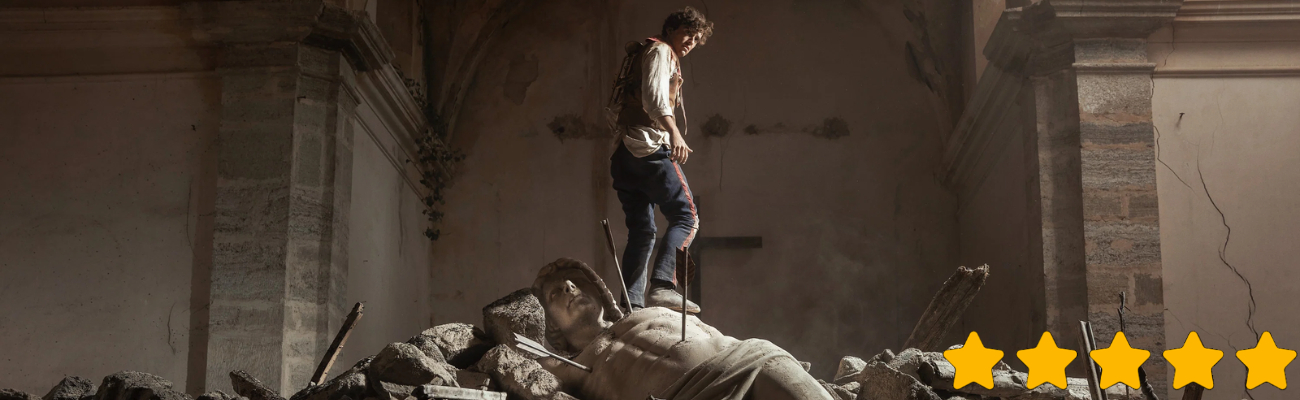
The film is split into three seemingly separate strands, each set in a different time period. The first takes place in 1932, when affluent young Carlos (Milo Quifes) attempts to gain membership of an elite social club, only to find himself literally blackballed (as in, they use white and black balls to vote either for or against his admission) due to heavy rumours regarding his sexuality. The second, a few years later in 1937, follows young trumpeter Sebastián (Guitarricadelafuente) joining the Nationalist army after surviving their attack on his home village, and who ends up guarding and developing strong feelings for Republican POW Rafael Rodríguez Rapún (Miguel Bernardeau), whom Lorca historians will know to have been a very close companion to the playwright himself. Finally, decades later in 2017, young historian Alberto (Carlos González) learns that he has inherited something very special from his recently passed grandfather whom he never knew, and it is that special something which ends up tying all three storylines together in unexpected and history-defying ways.
From the very first scene, which lulls you into a false sense of security before blowing up any and all expectations, Los Javis lock you in with a style and sense of emotion all their own. The filmmakers constantly flirt with magical realism, particularly within the 1932 segment where scenes will suddenly become heavily choreographed interpretive dance sessions or even dive into surreal territory with particular personifications (without spoilers, there’s a very good reason as to why specifically this section is like this), while embracing the confined spectacle of the latter segments as they dig deep into the protagonists’ tender souls as they face repression and self-uncertainty, albeit under wildly different historical contexts, amidst some heavy historical events. It’s rare to see filmmakers like Los Javis take such an ambitious leap with their craft yet still keep the attention squarely on the story and characters rather than their own style, indicating that their passion for the material is not just genuine but efficient.
While it isn’t about Lorca himself (he appears in a couple of brief monochrome flashbacks, and that’s it), La Bola Negra is much more of Lorca, and Los Javis do extremely well to replicate much of the writer’s unique storytelling and dialogue for a multi-layered script that carries many of his recurring themes in an even load, from love and desire to marginalised identities and more. But rather than simply doing a pastiche of it all, the filmmakers use the opportunity to show them in greater detail than Lorca himself could have imagined back in his day. Scenes in the 1937 segment, for example, showcase rampant homoeroticism as soldiers swim and bathe naked on nearby beaches, all within an ironic heterosexual context, while a key sequence involving a cameoing Penélope Cruz embraces the extravagant flamboyance of queer-friendly entertainment for, again, a largely straight crowd. They’re presented with stunning flair, thanks to vibrant cinematography and finely tuned editing that makes it all fly by across its lengthy runtime, ensuring that the themes which Lorca originally wrote about are as passionate as they were when he crafted them.
It grips you with plenty of compelling characters and heavy, often very emotional drama to a point where it can potentially overwhelm the viewer, but Los Javis know just how to utilise those tools at the most appropriate time. By spacing out these segments across each other, the filmmakers take you on a multi-layered journey where you’re invested in each separate strand, thanks also in part to some excellent performances across the board, with major standouts being Guitarricadelafuente, the Spanish musician making one hell of an acting debut here, and the ever-great Glenn Close in a small but important role during the 2017 section.
But of course, the real star is the burning passion that Los Javis have for Lorca’s work, an adoration that will no doubt rub off on viewers who, thanks to the majestic epic that is La Bola Negra, may be inspired to seek out the various works that were left in the wake of the artist’s murder. If that indeed ends up being the case, then it’ll be yet another shining example of how the generational talent continues to laugh in the face of his own demise.
SO, TO SUM UP…
La Bola Negra is a fantastic historical epic that explores and embraces the complex emotional themes of Federico García Lorca in a multi-layered narrative that filmmaking duo Los Javis present with burning passion, luscious visual style, and heavy emotion which makes for one hell of a viewing experience.



Other recent reviews:









0 Comments