
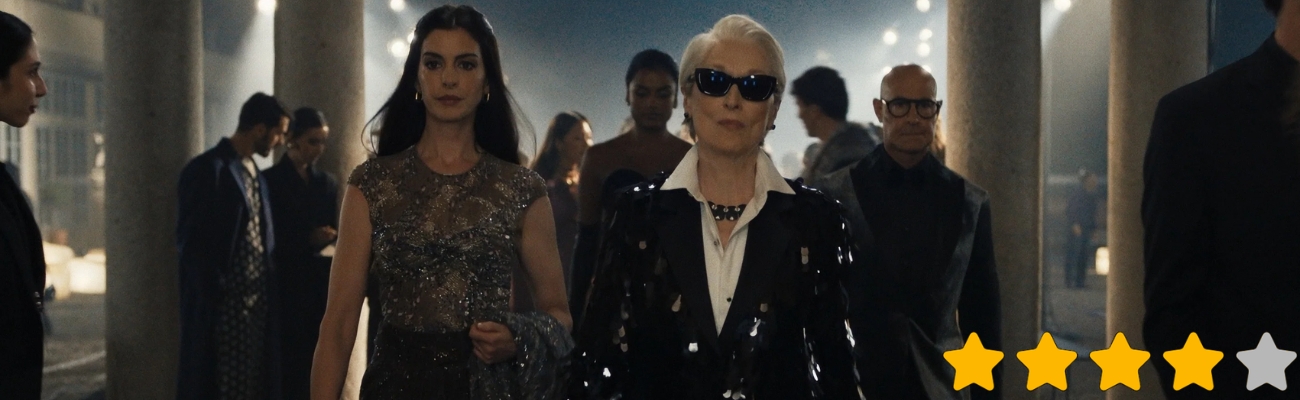
The Devil Wears Prada 2 (dir. David Frankel)

Certificate: 12A
Running Time: 119 mins
UK Distributor: 20th Century Studios
UK Release Date: 1 May 2026
WHO’S IN THE DEVIL WEARS PRADA 2?
Meryl Streep, Anne Hathaway, Emily Blunt, Stanley Tucci, Justin Theroux, Kenneth Branagh, Tracie Thoms, Tibor Feldman, Simone Ashley, Lucy Liu, Patrick Brammall, Caleb Hearon, Helen J. Shen, Pauline Chalamet, Rachel Bloom, B.J Novak
WHO’S BEHIND THE CAMERA?
David Frankel (director), Aline Brosh McKenna (writer), Wendy Finerman (producer), Theodore Shapiro (composer), Florian Ballhaus (cinematographer), Andrew Marcus (editor)
WHAT’S IT ABOUT?
Miranda Priestly (Streep), the editor of Runway Magazine, seeks to navigate a modern fashion landscape…
WHAT ARE MY THOUGHTS ON THE DEVIL WEARS PRADA 2?
It is a little unfair that The Devil Wears Prada has fallen into the archaically named “chick flick” category. While it’s true that the 2006 David Frankel-directed film carries heavy qualities that at first seem like they appeal more to women than men – such as the fashion theme, the largely female main cast, and a poppy soundtrack seemingly designed by nature to attract the attention of the opposite sex – it is a lot more gender-neutral than some give it credit for. It is, at its heart, the story of someone who attempts to make it in a business they’ve been thrown into the deep end of, learning to accept and even embrace their new responsibilities, and realising how much of their humanity may be the ultimate price to pay… all while working underneath an utter tyrant of a boss. Now that is something which anyone, man or woman, can all too easily relate to.
Twenty years later, with the long-awaited arrival of a sequel with the original cast and crew (including Frankel and screenwriter Aline Brosh McKenna) all returning, the gender-neutral appeal remains stronger – dare I say it, even more necessary – than ever. That’s because The Devil Wears Prada 2 is a legacy sequel that is actually about a legacy, not just that of the iconic characters but also of the world of journalism they operate within, and how along with an alarming number of media outlets it is slowly going the way of the dinosaurs. Frankel’s follow-up thereby serves as a welcome rallying cry for journalists who are not yet ready to face extinction, in addition to being a strong sequel that both fans of the original and newcomers will consider to be extremely vogue.
The film begins with Andy Sachs (Anne Hathaway), now a respected and award-winning journalist, being abruptly laid off with the rest of her team – by text, right in the middle of an awards show, incidentally – after their outlet is bought out. She’s suddenly jobless, but not for long as Andy is soon approached for the swanky position of features editor at none other than her old haunt at Runway, the fashion magazine that is still being operated by its icy editor-in-chief Miranda Priestly (Meryl Streep) and her right-hand man Nigel Kipling (Stanley Tucci). Miranda, however, isn’t quite her usual cold self, especially after a scandal involving a recently-published article has dropped the magazine in hot water, with Andy there to help rehabilitate the brand’s image and cool relations with advertisers, among them Miranda’s former assistant Emily Charlton (Emily Blunt) who now works over at Dior. But with the future of Runway up in the air amidst an uncertain modern climate, Andy must work with Miranda, Nigel and even Emily to save the publication from folding for good.
Like most legacy sequels, there’s quite a bit of nostalgia-baiting as certain moments, lines of dialogue and even exact shots are referenced or repurposed in some way, but luckily that’s not all the film is. Rather than simply relying on fan service or just rehashing the same plot, it instead tackles fresher themes and ideas that put the ones from the first film into an all-new perspective, in this case what it’s like to be a journalist like Andy operating at a publication that at any moment could be swallowed up by the demands of our current online culture. Before Andy arrives back in the office, Runway has already become a shell of its former self, the print magazine now all but completely online with clickbait articles and tacky short-form video content prioritised over articles of actual substance. It’s left even the quietly domineering Miranda, whose simple pouting of the lips could once kill an entire fashion line, with little authority left of her own, much of it swallowed up by external input from much younger tech billionaire investors and internal HR complaints about her overbearing nature.
While the film certainly sees the funny side of it all – the sight of Miranda struggling to hang up her own jacket, years after just flinging it onto her assistants’ desks, is amusingly cathartic – The Devil Wears Prada 2 also doesn’t shy away from how devastating the prospect of irrelevance in this age of modern media can be. The film works best when it is raising key issues about journalistic integrity and the importance of its role in our general culture, with McKenna’s smart and keenly focused script offering meaningful empathy toward those whose undeniable passion and idealism might not be enough to keep a juggernaut like Runway afloat. It handles it all with a strong amount of sincerity and heart, neatly conveyed by an exceptionally talented cast who continue to make characters who might otherwise have come across as obnoxious caricatures feel like real humans trying to stay afloat in the same sinking boat.
Sometimes, it can feel a little light in its overall conflict, with one or two things literally being solved by a few simple phone calls, and there is the occasional caricature that pops up who feels like they’re from a completely different kind of movie. But just as much as the first film did, arguably even more so, The Devil Wears Prada 2 surprises with its insightful wisdom about how maintaining a legacy in this day and age, especially within the media industry, is not as easy as it may have been two decades earlier.
With that, it successfully maintains the winsome appeal that helped make the original film a beloved film for all genders, while also expanding upon its universality in ways that feel frightfully relevant to anyone operating in that world, whether they’re a struggling film critic or the head of a high-end fashion magazine.
That’s all.
SO, TO SUM UP…
The Devil Wears Prada 2 wisely tempers its nostalgia-baiting in favour of a surprisingly meaningful study of how modern media is slowly eroding the soul of passionate cultural outlets, making it an unexpectedly worthy sequel.


Other recent reviews:

0 Comments