
The Good Boy (dir. Jan Komasa)

Certificate: 15
Running Time: 110 mins
UK Distributor: Signature Entertainment
UK Release Date: 20 March 2026
WHO’S IN THE GOOD BOY?
Stephen Graham, Andrea Riseborough, Anson Boon, Kit Rakusen, Monika Frajczyk, Savannah Steyn, Callum Booth-Ford, Austin Haynes
WHO’S BEHIND THE CAMERA?
Jan Komasa (director), Bartek Bartosik and Naqqash Khalid (writers), Ewa Piaskowska, Jerzy Skolimowski and Jeremy Thomas (producers), Abel Korzeniowski (composer), Michał Dymek (cinematographer), Agnieszka Glinska (editor)
WHAT’S IT ABOUT?
A young criminal (Boon) is kidnapped and forced into an unusual rehabilitation scheme…
WHAT ARE MY THOUGHTS ON THE GOOD BOY?
The concept of Stockholm syndrome, that classic survival-based coping mechanism where victims generate empathy and loyalty toward their abusers, is always on your mind during Jan Komasa’s The Good Boy. The premise, as wild as it already is, never explicitly addresses the term itself, but that’s obviously what’s going on as the Polish director, working from a script by Bartek Bartosik and Naqqash Khalid, shows clear as day the gradual progress of what it’s like to psychologically submit to a twisted situation and even further warped environment.
Such a thing would be fine, even fascinating, if it weren’t for the fact that neither Komasa nor his screenwriters appear to know what tone to ultimately settle on. Since it’s never quite sure whether to treat itself as a dark comedy, a suspense thriller, or even a wholesome family drama, The Good Boy ends up sending mixed messages about what it’s trying to say, some of which are far more concerning than others when you pause to think about their disturbing implications.
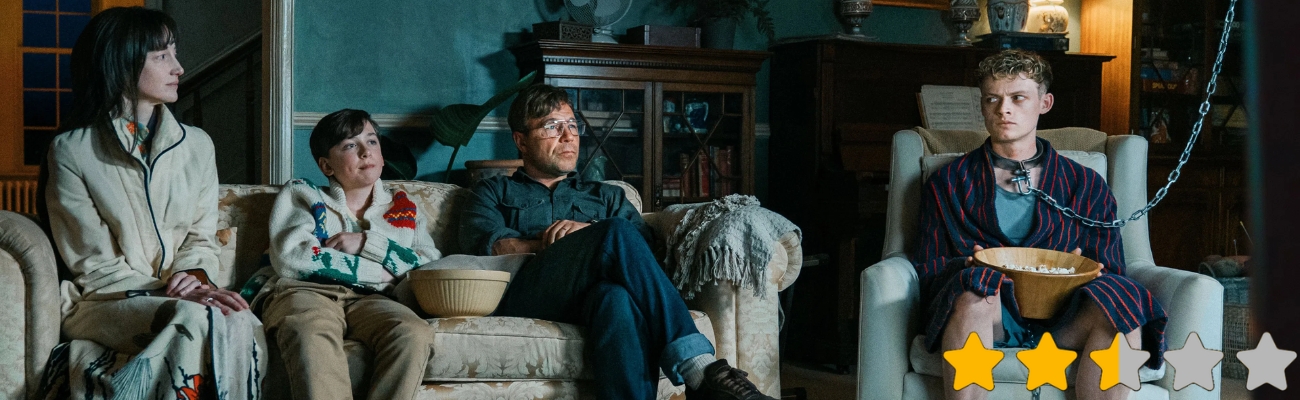
The film opens with Tommy (Anson Boon), an utterly repugnant young man, causing plenty of violent and sexual mischief during a booze-soaked and drug-fuelled night out on the town, which abruptly ends when he’s abducted by a stranger and wakes up chained by the neck in their ominous basement. Said stranger turns out to be Chris (Stephen Graham), a polite and well-dressed family man living on a secluded estate with his near-catatonic wife Kathryn (Andrea Riseborough) and their young son Jonathan (Kit Rakusen), who’s ever chipper but hiding a distressing need to please his parents. The family’s intentions with their new houseguest are simple: get him to understand and take responsibility for his thuggish behaviour, and take the path toward being a better, kinder and all-around acceptable member of society. Should he step out of line, he’s beaten or electrocuted into submission, which very much like an untrained dog – hence where the title The Good Boy comes into play – enhances his obedience training.
At first, Komasa positions his film as a straightforward kidnap thriller, albeit one with traces of dark comedy as the juxtaposition of the prim and proper environment and mannerisms displayed by the family against the dark secret underneath their feet gets a few uneasy chuckles. But then, the pitch-black humour starts to become more apparent, and while it doesn’t entirely forget about the thriller aspect it certainly isn’t as concerned with it as it was beforehand, leaving you uncertain whether to laugh with legitimacy or awkwardness. By the time you’ve figured that out, The Good Boy has reverted to a much more wholesome family drama, another piece of intentional juxtaposition but one that’s even further off from its horrifying context and much less sure of what it’s actually going for. Sprinkled in between are moments that once again recall that psychological thriller angle, like one harrowing scene of young Jonathan being cruelly punished by his parents for being caught with a pack of cigarettes, and even a brief gangster subplot involving Monika Frajczyk’s Macedonian housemaid Rina, but they are quickly forgotten before going right back to them being a happy(ish) family again.
If the filmmakers’ intention was to have the viewer feel as though they too are going through the bouts of Stockholm syndrome alongside its protagonist, it’s an oddly imbalanced way of showing it. Komasa seems unsure as to whether we should be fearing this family or connecting with them, for whenever it seems as though a genuine bond is forged it’s suddenly pulled back by some unnerving behaviour on their part, which reminds us that this is indeed a demented unit whose ultimate intentions remain murky at best. It doesn’t seem to be quite as difficult a task for Boon’s Tommy, in whom you see a gradual shift in personality as he’s subjected to self-published video posts depicting his horrific past behaviour (how Graham’s Chris was able to collate these onto an old-school VHS, let alone how Tommy himself didn’t get permanently banned from social media for posting such dangerously violent content, remains a mystery), as well as classic literature like To Kill a Mockingbird and Ray Bradbury’s The Illustrated Man, and even the classic film Kes which elicits the first genuine tear we’ve seen from this guy.
Boon’s performance is quite strong in that regard, as are the ones by Graham, Riseborough and Rakusen who, for all their warped nature, are convincing as a somewhat dysfunctional yet oddly charming family, enough to where you do understand a little bit as to why Boon’s Tommy would be won over onto their side. But that doesn’t fully shake the uncomfortable vibes one gets from a film that ultimately doesn’t seem confident in its ability to address the psychological toll of what is effectively a brainwashing procedure, especially with an ending that is presented as this major heartfelt gesture despite the implications, and what it’s trying to teach, being pretty horrific in retrospect.
Again, this would be fine if the film maintained a consistent tone throughout, but the muddled approach leaves The Good Boy with less on its mind than it’d like to think, with the only way you’d fully get behind its twisted mentality is if you too develop Stockholm syndrome whilst watching it.
SO, TO SUM UP…
The Good Boy is an oddly imbalanced kidnap thriller that seeks to address and replicate the process of Stockholm syndrome, but despite strong performances from the likes of Stephen Graham and Anson Boon, an inconsistent tone that fluctuates between dark comedy and wholesome family drama further warps the misguided messaging.


Other recent reviews:


0 Comments