
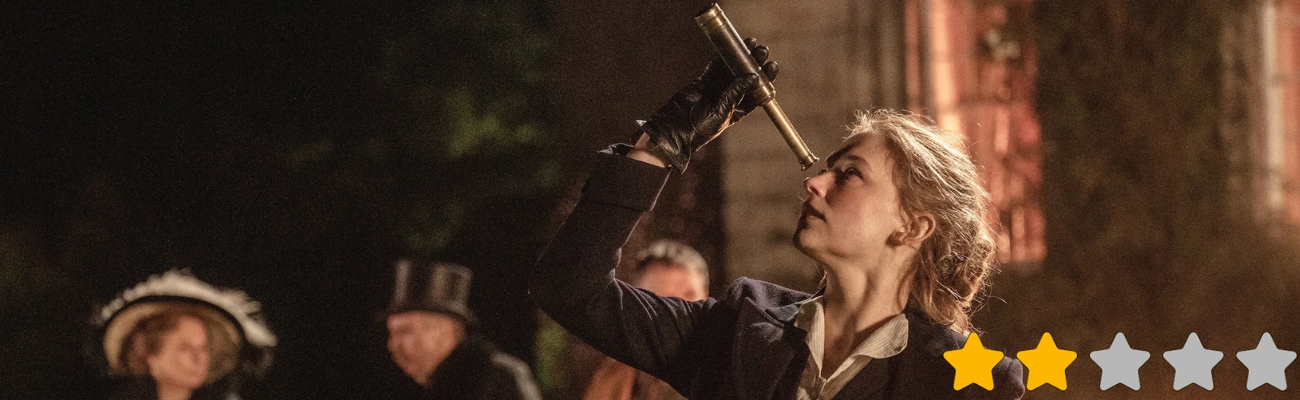
Virginia Woolf’s Night & Day (dir. Tina Gharavi)

Certificate: 12A
Running Time: 95 mins
UK Distributor: Vue Lumière
UK Release Date: 19 June 2026
WHO’S IN VIRGINIA WOOLF’S NIGHT & DAY?
Haley Bennett, Lily Allen, Timothy Spall, Elyas M’Barek, Jack Whitehall, Jennifer Saunders, Sally Phillips, Misia Butler, Alex Macqueen, Simon Phillips, Frances Barber
WHO’S BEHIND THE CAMERA?
Tina Gharavi (director), Justine Waddell (writer, producer), Christopher Figg, Julie Link, Philipp G. Steffens and Meg Thomson (producers), Simon Goff (composer), Sebastian Edschmid (cinematographer), Hansjörg Weißbrich and Ben Wilson (editors)
WHAT’S IT ABOUT?
An aspiring astronomer (Bennett) finds herself stifled by the expectations of her time…
WHAT ARE MY THOUGHTS ON VIRGINIA WOOLF’S NIGHT & DAY?
In 1919, before Orlando and even before Mrs Dalloway, acclaimed 20th century novelist Virginia Woolf wrote a novel called Night and Day – but if you were to ask the writer herself about it, even she would like to pretend it didn’t exist. In a later diary entry, Woolf famously decried her own realist style of writing that she brought to the novel, which received mixed reviews at the time of its release and even to this day is seen as one of the author’s lesser works. The book itself is, frankly, not very good, for while it certainly isn’t short on ideas, especially for the time period in which it is set, its rather flat narrative and unengaging characters dull its intended impact.
All credit in the world, however, to director Tina Gharavi and screenwriter/producer Justine Waddell for attempting to bring the rarely adapted book to the screen with Virginia Woolf’s Night & Day, but the truth about the story itself sadly remains true to this day. Like the book it’s based on, the film is a lesser work that tries to make its source material more relevant for a modern audience, only to still feel somewhat regressive in its overall execution.
Set in early 20th century England, we focus on Katherine Hilbery (Haley Bennett), a young woman with a keen passion for astronomy and a burning desire to make it as a fully qualified astronomer on her own terms. However, this being the time period that it is, the patriarchal society at large – represented by her furiously conservative father (Timothy Spall) – would rather her be married off at the earliest convenience, with a union between childhood friend William Rodney (Jack Whitehall) being practically forced upon her. However, Katherine refuses to let the expectations of her peers get the better of her, and resolves to further her research in order to potentially apply for a coveted position at Cambridge University, while dealing with some unexpected life-changing encounters along the way, some of them including her beloved cousin Cyril (Misia Butler), free-spirited suffragette Mary (Lily Allen) and handsome working-class editor Ralph (Elyas M’Barek), who’s been brought in to assist Katherine’s mother (Jennifer Saunders) with finishing her long-awaited manuscript.
From that, it sounds like there’s a fair bit going on in this movie, but while that is technically correct it all rarely ever comes together as much as it should. Waddell’s script sticks perhaps a bit too closely to Woolf’s original story, therefore a lot of the same issues – from its wavy and sometimes unfocused storytelling, to character arcs that either go nowhere or contradict themselves by the very end – are present in this adaptation, rather than being amended to better reflect the nature of today’s world. There are parts of Ghavari’s direction where you can tell there’s at least some idea of postmodernism, with numerous scenes being shot with handheld camerawork and set to a smooth synth-like soundtrack that make it feel like something that Sofia Coppola would have directed, but this directorial style doesn’t contrast exceptionally well to the more traditional writing.
This is especially apparent whenever Virginia Woolf’s Night & Day attempts to hammer in its messages of feminism and independence. Of course, there’s nothing wrong with either of these themes, but the ways in which the film depicts them is beyond heavy-handed, to a point where it almost defeats the purpose with how overly insistent they can feel. Scenes where Haley Bennett’s Katherine faces blatant prejudice first-hand, including an early male-dominated vote on allowing women basic rights and a later family meal where a father constantly berates their own offspring for being who they are, can come off as hollow rather than upsetting, since it’s made so abundantly clear what the script is trying to say that any sense of subtlety has gone out the window. Moreover, characters that represent these very themes such as Lily Allen’s Mary largely feel shoehorned into the story, ultimately serving little narrative purpose other than to give the protagonist a much-needed boost of support.
It is ultimately a film which says nothing that other historical costume dramas of this variety haven’t already said, and in trying to expand upon certain themes it feels more desperate to have something of relevance in order to attract attention in our oversaturated market. The cast are certainly doing their best, particularly Bennett, but they are still saddled with characters who remain frustratingly one-note throughout, and thus have few interesting qualities about them which in some cases aren’t that different from your average Jane Austen story or even an average Disney movie. Furthermore, while it isn’t a poorly made film or even a poorly shot one, Ghavari’s overtly stylish direction doesn’t seem like the right fit for this kind of material, as there’s little about neither Woolf’s story nor Waddell’s adaptation which lend themselves to such a radical visual reinvention.
The best place for a movie like this to exist is on terrestrial television during a Sunday afternoon, a time when particular age groups can tune in whilst their roast lunch goes through their systems, the harmlessness of it helping it all to go down much smoother. Other than that, while it is noble of the filmmakers to try and bring life to a lesser-known novel by the famed author, their take on Night and Day doesn’t exactly fix the lingering issue of the novel itself not being very good.
SO, TO SUM UP…
Virginia Woolf’s Night & Day nobly attempts to bring the novelist’s lesser-known book into contemporary relevance, but its lack of narrative engagement and heavy-handedness of certain themes keep it from achieving its goals.



Other recent reviews:










0 Comments