
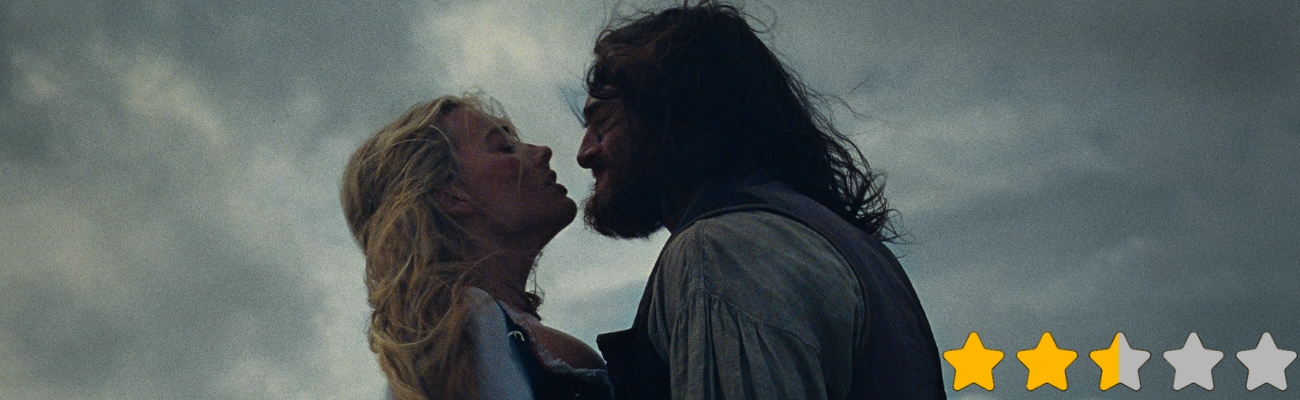
“Wuthering Heights” (dir. Emerald Fennell)

Certificate: 15
Running Time: 138 mins
UK Distributor: Warner Bros
UK Release Date: 13 February 2026
WHO’S IN “WUTHERING HEIGHTS”?
Margot Robbie, Jacob Elordi, Hong Chau, Shazad Latif, Alison Oliver, Martin Clunes, Ewan Mitchell, Charlotte Mellington, Owen Cooper, Vy Nguyen
WHO’S BEHIND THE CAMERA?
Emerald Fennell (director, writer, producer), Tom Ackerley, Josey McNamara and Margot Robbie (producers), Anthony Willis (composer), Linus Sandgren (cinematographer), Victoria Boydell (editor)
WHAT’S IT ABOUT?
The tragic romance between Catherine Earnshaw (Robbie) and Heathcliff (Elordi)…
WHAT ARE MY THOUGHTS ON “WUTHERING HEIGHTS”?
If one were to describe Emerald Fennell’s “Wuthering Heights” (emphasis on the quotation marks) in a single hyphenated word, it would be “old-fashioned” (another emphasis on the quotation marks). Hers is a film where everything from the costumes to the cinematography to the set design to even the central casting are not unlike what you’d see in a major studio production during the Old Hollywood era, where nuance was but a mere suggestion as films like Gone with the Wind, Citizen Kane and Ben-Hur indulged in on-camera extravagance to a point where the classicist narrative format threatened to be consumed by their own lavishness.
Fennell is clearly aiming for a similar effect of old-fashioned-ness with her interpretation of Emily Brontë’s classic novel, but in adding her racier tendencies from previous films Promising Young Woman and especially Saltburn, Fennell has crafted an unusual hybrid of Old Hollywood excess and postmodern sexual liberation. If nothing else, this is certainly an interesting direction to go in with this particular piece of literature, albeit at the risk of incurring the wrath of its most hardcore traditionalist fans. However, as a film of its own accord, “Wuthering Heights” can’t help but feel as though something is missing amidst the undeniable handsomeness of the production, something which gives it a soul beneath the gorgeous exterior.
As in the book, the film charts the lifelong 18th century romance between Catherine Earnshaw (Margot Robbie), who lives on the titular estate within the Yorkshire Moors with her volatile father Mr. Earnshaw (Martin Clunes), and Heathcliff (Jacob Elordi), the orphaned lad who was taken off the streets to work for the family. Their attachment to one another is strong, but due to Heathcliff’s lowly status Catherine finds herself marrying her wealthy neighbour Edgar Linton (Shazad Latif) instead, leaving the jealous Heathcliff to disappear and then return years later as a bitter, spiteful and mysteriously wealthy man with his sights still set firmly on her. Luckily for him, her feelings for him have also remained the same, and so begins a torrid and – in true Fennell fashion – somewhat twisted love affair, one that also factors in Edgar’s adorkable young ward Isabella (a standout Alison Oliver) who takes a fancy toward the brooding Heathcliff.
I am no expert on Brontë’s original novel, so don’t expect this review to get into what’s different in Fennell’s film compared to the source material (though I am indeed aware of the whitewashing allegations surrounding Elordi’s casting as someone described in the book as being of darker skin). What I can do, however, is look at “Wuthering Heights” from the angle of it being a form of cinematic language, and in that regard, there is certainly a lot to discuss, both positive and less so. For one, the production values are absolutely stunning, with the intricate sets and costumes, as well as Linus Sandgren’s strikingly colourful cinematography, ensuring that there is always a sense of extravagant beauty in nearly every single frame. It really does feel like something out of the Old Hollywood era, particularly in the way that certain locations look like they were clearly shot on traditional sound stages, while the ways in which particular hues and silhouettes are cast during sunsets and fog-laden wanders across the Moors recall the epic nature of a classic Victor Fleming production (Gone with the Wind is clearly a major influence, right down to the film’s poster mirroring the classic promotional pose between Clark Gable and Vivien Leigh).
Fennell uses these vast filmmaking elements to present a purely visual interpretation of the source material, one that could almost be mistaken for a high-end photoshoot for Vogue magazine that so happens to be accompanied by an atmospheric Charli XCX soundtrack. But like with most purely visual productions, “Wuthering Heights” ends up being a lot of stylish flash with little substantial impact, as the filmmaker struggles to convey a deeper understanding of the central relationship, the complexities of which seem to have been removed and replaced with little more than fanciful yearning between Robbie and Elordi. Though neither are lacking in charisma nor in chemistry with one another, the performers can’t quite shake the feeling that they’re just acting opposite each other rather than actually being these characters, whose uglier and even narcissistic tendencies make it more difficult to root for their romance despite the actors’ best efforts to make them seem more palatable.
To make matters more confusing, the filmmaker adds an extra few doses of eroticism that clearly worked wonders for her in Saltburn, but in something like “Wuthering Heights” come across much more as being provocative for the sake of provocation. Case in point, the very first scene features the outline of a visibly erect penis through the trousers of a person being hanged, while later we get not one but two instances of BDSM relationships that involve horse muzzles and even a bit of pup play. None of these additions truly add to the central narrative, other than to appeal toward a sexually starved audience who can’t get through a Brontë novel without feeling horny. But even the added sense of desire comes off as surprisingly conservative, as those who express enthusiasm for such things here are seen either as monstrous enablers or helpless figures deemed by others to be in need of saving, which undercuts the feelings of liberation that Fennell clearly wants both her characters and the audience to feel.
So, is the movie good? It’s hard to say. On the one hand, you have to hand it to Fennell for committing to such a bizarre and overwhelmingly artistic vision, seemingly without compromise or pushback from the powers that be. But on the other hand, her film is emotionally hollow due to a fixation on the style over the substance that dilutes whatever interest you may have had with this story and these characters, all while saying or doing nothing that makes it stand out from the many other adaptations other than being a lot saucier than usual.
Instead, I like to think of “Wuthering Heights” as an experiment to meld old-fashioned Hollywood sentimentality with modern-day provocation and see if they create something new and exciting. In this case, though, the results of this experiment are frustratingly inconclusive.
SO, TO SUM UP…
“Wuthering Heights” is a middling experiment by filmmaker Emerald Fennell to combine old-fashioned Hollywood methods, including lavish production design and strikingly colourful cinematography, with her own sense of playful yet out-of-place provocation, which ends up creating a version of Emily Brontë’s novel that certainly titillates but never inspires.



Other recent reviews:





0 Comments