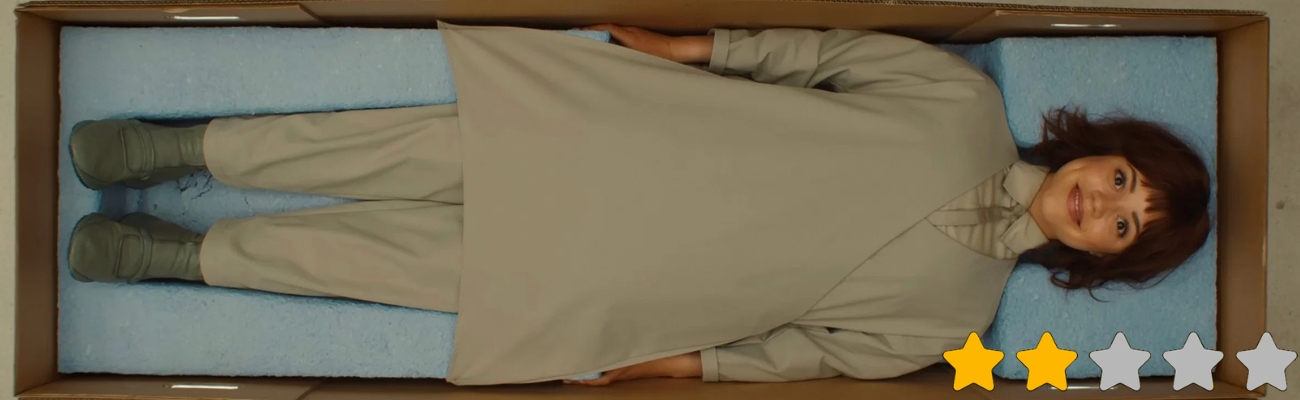
Klara and the Sun (dir. Taika Waititi)

Certificate: 12A
Running Time: 116 mins
UK Distributor: Sony Pictures
UK Release Date: 23 October 2026
WHO’S IN KLARA AND THE SUN?
Jenna Ortega, Amy Adams, Mia Thaira, Aran Murphy, Natasha Lyonne, Steve Buscemi, Rachel House, Harry Greenwood, Sophia Bryant-Taukiri
WHO’S BEHIND THE CAMERA?
Taika Waititi (director, writer, producer), Dahvi Waller (writer), Garrett Basch and David Heyman (producers), Michael Giacchino (composer), Mike Berlucci (cinematographer), Tom Eagles and Adam Gough (editors)
WHAT’S IT ABOUT?
An android (Ortega) sets out to find her purpose…
WHAT ARE MY THOUGHTS ON KLARA AND THE SUN?
If there’s a piece of online lore that one could use to describe the bizarre authorial unevenness of Klara and the Sun, director and co-writer Taika Waititi’s adaptation of the similarly named novel by Kazuo Ishiguro, it’s the “Hydrogen Bomb vs. Coughing Baby” meme. If it wasn’t already obvious, in this scenario Waititi is the hydrogen bomb and Ishiguro the coughing baby: as the filmmaker, Waititi of course has the power to reshape the source material into his own distinctly quirky and comically overbearing image, but in doing so he all but annihilates the narrative and emotional complexities of the author’s work, which by comparison is much more straightlaced and eerily dystopian.
As you can imagine, it creates a film that desperately wants to be a mouthpiece for both of these wildly distinct voices, but creates something much more jumbled and uncertain of itself, ultimately malfunctioning under the weight of its own tonal confusion.
The film is set in a dystopian future that’s been ravaged by pollution, class division and international war (all of which are very quickly glossed over, thanks to Waititi being Waititi), and is told from the perspective of Klara (Jenna Ortega), a solar-powered android who lives in a rundown high street store with her fellow “Artificial Friends” who have been build to serve as companions for the children of the present. Klara is eventually chosen to be the AF of Josie (Mia Tharia), a sickly young teen who is also part of a select group of “lifted” youth that have been genetically altered to enhance their intelligence, and quickly finds herself living with Josie, her mother Chrissie (Amy Adams) and their housekeeper Melania (Waititi regular Rachel House) in their secluded home in the countryside, surrounded by wheat fields wherein a menacing, heavily polluting combine harvesting machine also operates. But as Josie’s condition inevitably worsens, Klara calls upon the one being she constantly relies on: the sun itself, which she believes to be a living being who sets every night in a distant barn and, just as it does with her, brings life and health to those that bask in its light.
It’s here where you can see the deeper themes of Ishiguro’s novel trying to seep out, as there’s an interesting commentary to take away from this about putting blind faith in religious deities to distract from the harsh realities of our world, which is further enhanced by the eerily relevant sci-fi themes involving AI and genetic engineering. However, Waititi doesn’t seem as interested in all of that, and instead emphasises the quirkiness in an adaptation that aims for more of a comedic approach which feels ill-suited to this material. His regular idiosyncratic dialogue and exaggerated direction frequently clashes with the concerning and often harrowing drama of a story where grief plays a big part yet is sometimes treated as though it’s yet another punchline in the world’s most confusing joke, and that can make it very difficult to understand what the filmmaker’s ultimate intentions are.
Technically speaking, Waititi is far from incompetent behind the camera, as he knows how to frame a shot and utilise some nicely atmospheric cinematography, and to an extent he also knows how to direct his actors, including Ortega who revels in a much peppier and upbeat role than the ones she’s been saddled with lately. But he is also a filmmaker who can’t seem to help himself, as his constant desire to insert comedy into everything, even when the moment doesn’t call for it, can wildly distort the ultimate message within the narrative, to where its silliness can override the more serious implications. With Klara and the Sun, it’s all the more frustrating since you do want to be invested in this story and its characters as well as its wider themes, but it undercuts the dramatic rhythm so frequently that you’re never sure whether to laugh or cry.
There are even times when the filmmaker’s overly wacky tone creates feelings of absolute confoundment, such as one sequence where a major character suddenly attempts to more or less murder the title character by holding them underwater, only for it to then cut to Klara throwing up all the water like it’s a scene from Monty Python’s The Meaning of Life. Later on, there is a scene involving a group of bullies that is so bizarrely executed, from certain acting choices to its use of sound effects and particular camera shots, that it feels like it’s come from an entirely different movie, especially when it’s followed almost immediately by a particularly poignant plot development. It only gives itself a rest as it heads into the third act, but even then the damage is done to a point where any hints of seriousness, especially when a particular twist straight out of Black Mirror makes itself known, always come with an uncertain asterisk.
Waititi simply wasn’t the right choice to adapt this more ponderous and cerebral source material, and that really shows in a film that is wildly uneven in how it tries juggling both his and Ishiguro’s voices but somehow ends up with a custard pie in its own face. It is disappointing, because both artists do have such unique voices that, when utilised properly, can produce some truly profound work, but when put together it becomes so much more apparent that they, much like the hydrogen bomb and coughing baby, should have been kept far away from each other.
SO, TO SUM UP…
Klara and the Sun is a frustratingly uneven blend of filmmaker Taika Waititi’s quirky comedic style and author Kazuo Ishiguro’s narratively and emotionally complex themes, which when fused together create a tonal mismatch of epic proportions that malfunctions under its own confusion.



Other recent reviews:








0 Comments