
Forgotten Island (dirs. Joel Crawford and Januel Mercado)

Certificate: PG
Running Time: 109 mins
UK Distributor: Universal Pictures
UK Release Date: 16 October 2026
WHO’S IN FORGOTTEN ISLAND?
H.E.R., Liza Soberano, Dave Franco, Jenny Slate, Manny Jacinto, Dolly de Leon, Jo Koy, Ronny Chieng, Lea Salonga, Kevin McCann, Amielynn Abellera, Sophia Laforteza
WHO’S BEHIND THE CAMERA?
Joel Crawford and Januel Mercado (directors, writers), Mark Swift (producer), Nathan Matthew David (composer), James Ryan (editor)
WHAT’S IT ABOUT?
Two childhood friends (H.E.R. and Soberano) venture to a mythical land that tests their friendship…
WHAT ARE MY THOUGHTS ON FORGOTTEN ISLAND?
It’s times like this when I sadly realise that I’m no longer the energetic youth that I once was. I imagine that ten years ago, my mid-20s self would have been far more into Forgotten Island that my present mid-30s self is, because while it’s hard to deny that DreamWorks Animation’s latest film is a visual delight with style seeping out of every orifice, it is also a film where I found myself needing a serious nap afterwards, just to recover from the absolute fever dream that is this movie.
None of that necessarily makes it bad or even mediocre, as there is still plenty to admire about co-directors Joel Crawford and Januel Mercado’s latest film (following their excellent efforts on Puss in Boots: The Last Wish), many of which will no doubt inspire many other viewers, including and especially younger audiences. But I can only speak for my own experiences, and despite its strengths I did find myself rather exhausted by the onslaught of sensory intake from something that maybe embraces its hyperactivity a bit too much.
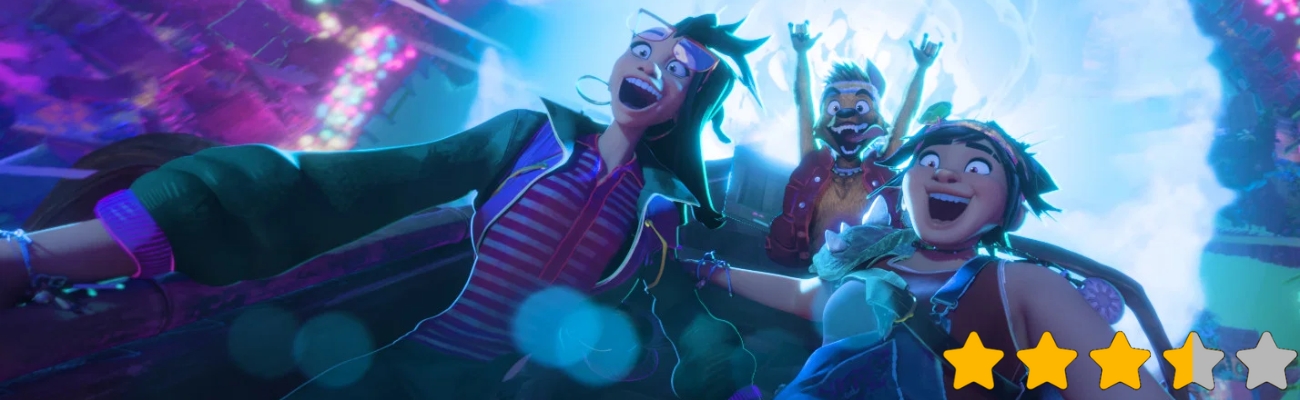
Set during the 90s in the Philippines, the film charts the friendship between imaginative Jo (H.E.R.) and the bookish Raissa (Liza Soberano) as they go from childhood besties to young adults, when their bond hits an impasse after Raissa reveals she’s heading to America for university, leaving Jo behind to sort her own life out. But on the night before Raissa is due to leave, the pair end up being transported to the mythical island of Nakali, home to many fantastical creatures from muscular mermen to shape-shifting were-dogs like the friendly Raww (Dave Franco). Except, when they awaken the next morning, the two find that they cannot remember anything that had happened the night before, forcing them to retread their steps so that they can find their way back home.
There is formidable strength in Crawford and Mercado’s script for the film, not just in its heavy embrace of Filipino culture and mythology, but also in how it handles the central relationship between Jo and Raissa, which gives Forgotten Island its unmistakable soul. The filmmakers inject real heart into these characters as you initially see their friendship grow over time and throughout the events of this movie, as the chemistry between them is palpable to where they could almost be conjoined siblings, their banter-filled back-and-forths so endearing to watch that you do feel bad whenever that bond is tested. Crawford and Mercado have clearly drawn from their own real-life friendship to make the one in their movie feel authentic, and it works in ways that make Forgotten Island its own wild tribute to friendships as a whole, complete with various photos during the credits of crew members and their own close pals.
The most striking aspect of this film is its visual style, which very much like Puss in Boots: The Last Wish goes for vividly colourful CGI graphics but with heavy 2D brush strokes, such as expressive lines underneath a character’s eyes or around their general outline, while the aspect ratio will sometimes slow down during a running scene. There is clearly a lot of inspiration from anime, especially with how certain characters and environments are designed – a villain moves with the janky nature of a classic stop-motion movie monster from the 1930s – and occasionally the film will even switch overall animation styles to a more hand-drawn aesthetic during humorous flashbacks, which are presented in a way that wouldn’t feel out of place among a regular kid-centric television schedule in Japan. It creates a vibrant and distinct visual identity that can often be dazzling, even mesmerising, to watch.
It’s too bad, then, that it’s all presented with the chaotic speed of a Japanese bullet train operating on a Mach 5 engine, which can seriously overwhelm anyone who isn’t operating on that exact speed. This is a very hyperactive movie, rapidly moving from one thing to the next without stopping for breath, or in this case character development and establishing this fantastical world beyond what we’re presented at face value. Even the comedy suffers, because after it delivers a joke or a visual gag it will instantly move on without giving you enough time to react, lest you miss the next dozen bits that it has up its sleeve. All of that can make for a somewhat obnoxious experience, because you want to explore this world and its inhabitants along with our two heroes, but it’s constantly throwing so much of its visual style and wacky humour at you that you’re always distracted and eventually exhausted by its hyperactivity, to where you lack the energy to take it all in.
That frantic pacing is really what prevented me from fully enjoying this movie. I can respect the fact that a lot of family movies nowadays, especially animated ones, need to go by at a certain pace so that children don’t become too bored, but for everyone else it can be tricky to admire the work put in by all these animators when there’s little time reserved to actually take a look at it. Forgotten Island, as visually dazzling as it is, sadly falls into that category, because while there’s a lot to appreciate about what they’ve done in terms of the writing, the animation style and the celebration of Filipino culture, it’s far too chaotic in its execution for its own good.
But at least it’s a fascinatingly designed execution (whenever we’re allowed to properly see any of it).
SO, TO SUM UP…
Forgotten Island is a visually and culturally pleasing animated film with a good amount of heart emerging from its winning central friendship, but the frantic pace at which much of the comedy and heavily stylised animation is delivered can make it a sensorily overwhelming and exhausting watch.



Other recent reviews:



0 Comments