
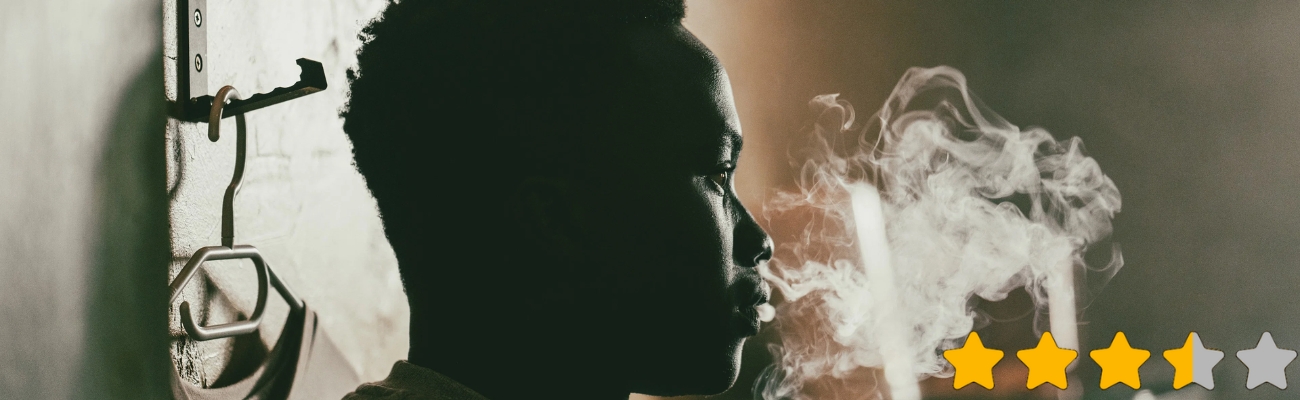
Animol (dir. Ashley Walters)

Certificate: 15
Running Time: 93 mins
UK Distributor: Sky Cinema
UK Release Date: 30 October 2026
WHO’S IN ANIMOL?
Tut Nyuot, Vladyslav Baliuk, Sekou Diaby, Stephen Graham, Sharon Duncan-Brewster, Ryan Dean
WHO’S BEHIND THE CAMERA?
Ashley Walters (director, producer), Nick Love (writer, producer), Joy Gharoro-Akpojotor and Thomas Hawkins (producers), Swindle (composer), Tasha Back (cinematographer), Danielle Palmer (editor)
WHAT’S IT ABOUT?
A young inmate (Nyuot) faces hostility in his new detention centre…
WHAT ARE MY THOUGHTS ON ANIMOL?
For anyone who ever wondered what may have happened in between that second and third chapter of Barry Jenkins’ Oscar-winning Moonlight, which – spoilers for a film celebrating its 10th anniversary this year – saw the young, emotionally conflicted protagonist be arrested for a violent crime before becoming a hardened gangster in his own right, allow me to direct your attention to Animol, which should fill that imaginative gap nicely.
While Ashley Walters’ directorial debut is not exactly the masterpiece that Moonlight was for Jenkins, it is similarly profound in its exploration of sensitive masculinity within an environment so openly hostile and unforgiving that any sign of sensitivity is seen as a vulnerable sign of weakness. It’s enough to overcome some of the film’s narrative redundancy, especially in the wake of harder hitting prison-set dramas like Wasteman, and establish Walters as a confident filmmaker who can tap into the fragile young male ego with impeccable ease.
The film follows young Troy (Tut Nyuot) as he is arrested under suspicion of a violent crime and remanded under custody at a youth detention centre, where he quickly experiences the tension among his psychopathic fellow inmates, including sinister smuggler Dion (Sekou Diably) and his unhinged cellmate Mason (Ryan Dean). However, he also finds a kindred spirit in another new arrival, Polish migrant Krystian (Vladyslav Baliuk) who’s in for trying to rob a library, and it’s through their budding friendship that Troy begins to feel a sense of hope about his new environment… until a point where, without giving much away, the film actually does become Moonlight.
Luckily, Walters has enough stability as a filmmaker, as well as fine material in Nick Love’s script, to quickly differentiate Animol with the likes of Jenkins’ movie. The director has an interesting way of focusing heavily on the humanity of its lead character without letting it become too melodramatic, with certain scenes showing his experiences through close-up shots of Nyuot’s face as the actor responds with stony resilience but also boyish fear as he witnesses sudden bursts of violence or is pressured by others to commit them himself. At times, the director also shows a keen, slightly surreal visual style that vaguely recalls Spike Lee (the auteur’s signature double dolly shot is implemented at one point here), but with its own gritty flavouring which gives Walters plenty of wiggle room to establish his own voice rather than take fragments from others.
It is certainly a film that leaves nothing to the imagination when it comes to the sheer brutality of these types of prison environments, where inmates will pick fist fights with others just for the thrill of it, and where the guards barely care about the young offenders they’re being paid to watch over. However, it’s hard to shake the feeling that you’ve seen it all before, likely because you actually have.
Animol doesn’t really do a whole lot that’s different compared to other prison dramas, with even its bleak and harsh tone being put to slightly more effective use in films like Wasteman and Starred Up, and it also doesn’t offer much that’s fresh in terms of showing the hostility of certain inmates, many of whom are comfortable just being two (at most) dimensional caricatures that we encounter along the way. The blame for this can largely be placed on Nick Love, whose script relies so heavily on typical prison tropes that it’s surprising that it doesn’t do the big prison-wide riot scene or have any corrupt wardens. It’s also a little strange as to why such a movie with all these delicate and sensitive topics was put in the hands of the guy who most recently wrote Marching Powder – though by comparison, Animol is by far the better-written movie of the two.
But again, Walters proves himself a capable enough filmmaker to work around the tropes within Love’s script and create an emotional viewing experience where you certainly do feel for our young protagonist, whom Nyuot plays with an empathetic soul within a hardened shell, and his similarly sensitive new friend Krystian. Admittedly, actor Vladyslav Baliuk perhaps looks a bit too like a Disney Channel heartthrob for this kind of grounded role, but he nonetheless impresses with his own boyish charm that fits well enough in this grounded universe. The starrier members of the ensemble are limited to brief supporting roles, though they too leave a strong impression, including Sharon Duncan-Brewster as Troy’s deeply flawed mother whose wobbly relationship with her son is expressed through subtle facial tics rather than full-blown dialogue, while Walters’ Adolescence screen partner Stephen Graham has a couple of standout moments in an otherwise limited role as a prison guidance counsellor.
If you were to ask me which recent prison drama I would heartily rewatch first, I would personally go with Wasteman, as I found that film to be a more immediate and intimidating experience which did a lot of the same things that this movie does, but just a little stronger. However, that doesn’t mean you should discount Animol right away, for while parts of it are certainly familiar, the film itself is a strong case for Walters to continue exploring his directorial voice, as he makes an assured debut here that works well with the flaws of the script and creates an effective atmosphere where, like young Troy, you feel trapped in a never-ending cycle of despair with only a small tinge of hope to see you through.
SO, TO SUM UP…
Animol is a confident directorial debut by Ashley Walters who creates a tense and sometimes stylishly bleak prison atmosphere out of Nick Love’s empathetic but largely familiar script, setting him up as a filmmaking talent to watch.



Other recent reviews:





0 Comments