
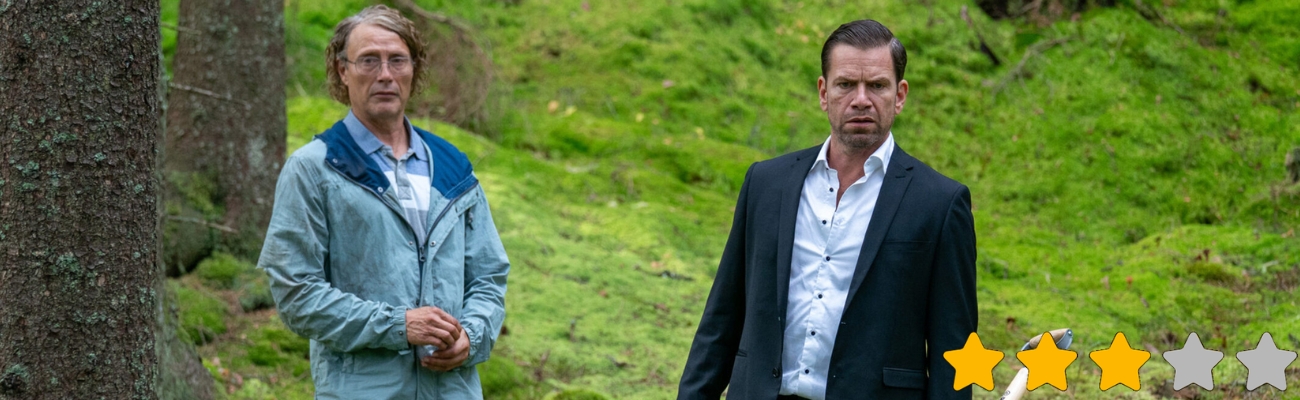
The Last Viking (dir. Anders Thomas Jensen)

Certificate: 15
Running Time: 116 mins
UK Distributor: Picturehouse Entertainment
UK Release Date: 26 June 2026
WHO’S IN THE LAST VIKING?
Nikolaj Lie Kaas, Mads Mikkelsen, Sofie Gråbøl, Søren Malling, Bodil Jørgensen, Lars Brygmann, Kardo Razzazi, Nicolas Bro, Peter Düring, Lars Ranthe, Anette Støvelbæk
WHO’S BEHIND THE CAMERA?
Anders Thomas Jensen (director, writer), Sidsel Hybschmann and Sisse Graum Jørgensen (producers), Jeppe Kaas (composer), Sebastian Blenkov (cinematographer), Anders Albjerg Kristiansen and Nicolaj Monberg (editors)
WHAT’S IT ABOUT?
An ex-con (Lie Kaas) must rely on his mentally unstable brother (Mikkelsen) to find his buried loot…
WHAT ARE MY THOUGHTS ON THE LAST VIKING?
Cinematic depictions of neurodivergence and mental illnesses (which, to clear up for the uneducated out there, are NOT the same thing) often tend to contribute towards society’s basic understanding of them, which sometimes does more harm than good. Thanks to films and shows like Rain Man, The Big Bang Theory, The Good Doctor and even – *shudder* – Sia’s Music, the general population seem to think that such things are exactly how they are depicted in the media, when the truth is that they are much more varied and complex than people give them credit for. As a neurodivergent person myself, one who has also had bouts with mental health at various points in my life, it is frustrating to see all these easily accessible movies and series fuel the consensus that people who identify as either or even as both should be pitied or mocked rather than treated with dignity and respect.
So, I’m in two minds about Danish writer-director Anders Thomas Jensen’s latest film The Last Viking. On one hand, it’s an amusing dark comedy that gets some decent laughs from the absurdity of the situation, as well as from the sudden and rather shocking bursts of violence. But on the other, it once again falls into that pattern of depicting neurodivergent and/or mentally ill people more as a punchline than actual people, in ways that could potentially reinforce the general public’s understanding of them to new misguided depths.
Right after a bookending animated sequence involving a Viking horde, the film begins with career criminal Anker (Nikolaj Lie Kaas) stashing away millions worth of recently stolen cash, entrusting it to his neurodivergent brother Manfred (Mads Mikkelsen) to whom he instructs to bury the goods in the woods by their old family home, where nobody would care to look for it. Fifteen years later, Anker is released from prison and immediately approaches Manfred for the location of the cash – except, Manfred has since developed Dissociative Identity Disorder and now believes himself to be none other than John Lennon, to where he impulsively harms himself or jumps out of moving cars and nearby windows whenever he’s referred to by his real name.
Needless to say, “John” doesn’t remember where he buried the money, so Anker reluctantly brings him along to the countryside house, now an Airbnb run by unhappily married couple Margrethe (Sofie Gråbøl) and Werner (Søren Malling), where he hopes to jog his brother’s memory of the exact location. Eventually, the method evolves into psychiatrist Lothar (Lars Brygmann) putting Manfed/John together with two other fellow DID patients Anton (Peter Düring) and Hamdan (Kardo Razzazi), who respectively believe they are Ringo Starr and both Paul McCartney and George Harrison (with touches of Heinrich Himmler and Davy Crockett here and there as well), to form a Beatles tribute band designed to allow them all to play out their delusions and therefore regain their true selves.
Much like someone with DID, The Last Viking juggles numerous personalities at the same time, each of them as far removed from one another as they can be. It will feel like a quirky buddy comedy one minute, and then the next transform into a grim thriller with enough mean-spirited violence to rival an early Ben Wheatley film, before jumping right into something surprisingly tender and even moving. In lesser hands, all of these distinct tones could cause the whole thing to spin out of control, so credit to Jensen for keeping it all focused enough to where the tonal transitions don’t cause too much of a whiplash effect, and in some cases work in harmony with one another to generate a few decent laughs, even if it’s just from the absurdity of the increasingly ludicrous situation.
But again, there is a certain discomfort one still gets from this film, and it really does come from its depiction of the aforementioned neurological conditions. While it’s far from being the least dignified cinematic portrayal, Jensen’s script still treats much of it as something to mock without truly taking the time to fully understand it. Instead of giving any of the DID-inflicted characters much depth, save for Mikkelsen’s Manfred/John, the film encourages the viewer to simply laugh at how eccentric and unpredictable these deeply mentally disturbed individuals are, without affording them any significant agency beyond their singular traits. It ends up contributing further discourse to the stigma that these conditions already face within larger society, the severity of which in some cases has led to an even greater decline in mental health among those who already feel grossly underrepresented and underappreciated in the wider world.
Most concerning is how, as is unfortunately common in the vast majority of films about neurodivergence or mental health, the character who actually has the condition isn’t even the main protagonist. Manfred is largely an accessory to the story of the far more neurotypical Anker, whose permanent scowl and thuggish behaviour towards family members and sometimes complete strangers already makes him particularly unlikeable, but while that’s certainly what Jensen was aiming to achieve with his anti-heroic lead figure, there is nothing charming about his arc or his overall character, or at least not enough for the viewer to favour his perspective over that of Manfred. Mikkelsen’s admittedly committed performance also outshines Kaas’s slightly more one-note turn, which further demonstrates how the focus was perhaps placed on the wrong person.
In all, it isn’t as though The Last Viking is a bad movie, because it still works as a dark comedy that’s both funny and sometimes effective. I just wish that it, as with many other films tackling this kind of subject matter, treated the conditions it’s highlighting with a bit more respect and less like a joke.
SO, TO SUM UP…
The Last Viking is an amusing dark comedy that offers some decent uncomfortable laughs during a tonally well-balanced narrative, but its mocking depiction of certain neurological conditions leaves a bad taste in the mouth.



Other recent reviews:




0 Comments