Leviticus (dir. Adrian Chiarella)

Certificate: 15
Running Time: 88 mins
UK Distributor: Picturehouse Entertainment
UK Release Date: 2 September 2026
WHO’S IN LEVITICUS?
Joe Bird, Stacy Clausen, Mia Wasikowska, Jeremy Blewitt, Ewen Leslie, Davida McKenzie, Nicholas Hope, Zahra Newman, Edwina Wren, Tyallah Bullock, Shannon Berry
WHO’S BEHIND THE CAMERA?
Adrian Chiarella (director, writer), Kristina Ceyton, Samantha Jennings and Hannah Ngo (producers), Jed Kurzel (composer), Tyson Perkins (cinematographer), Nick Fenton (editor)
WHAT’S IT ABOUT?
Two young lovers (Bird and Clausen) are terrorised by a shape-shifting demon…
WHAT ARE MY THOUGHTS ON LEVITICUS?
Horror can make you feel many emotions – scared, of course, but also anxious, contemplative, confused, and many more – but it’s rare that a horror film can leave you more angry than frightened. Not necessarily in the sense that what you’re watching is so awful that it leaves you feeling pretty pissed off (though there are definitely times when you can feel that kind of anger), but more in that it holds a mirror up to certain values and beliefs throughout society which are enough to leave any empathetic soul frothing at the mouth.
In writer-director Adrian Chiarella’s Leviticus, the anger is aimed towards the hate that certain marginalised people, in this case those who identify as LGBTQIA+, still receive from communities, religious sects and even their closest relatives, many of whom are too stubborn or ignorant to accept that love has evolved far beyond mere heterosexuality. Chiarella morphs this into an effective supernatural chiller where the scares come not from things outside of our reality but instead from how backwards-minded some people can be to a point where they’re willing to put their own children in harm’s way to expel whatever “demons” may be within them, all because a pair of boys happen to fancy each other.
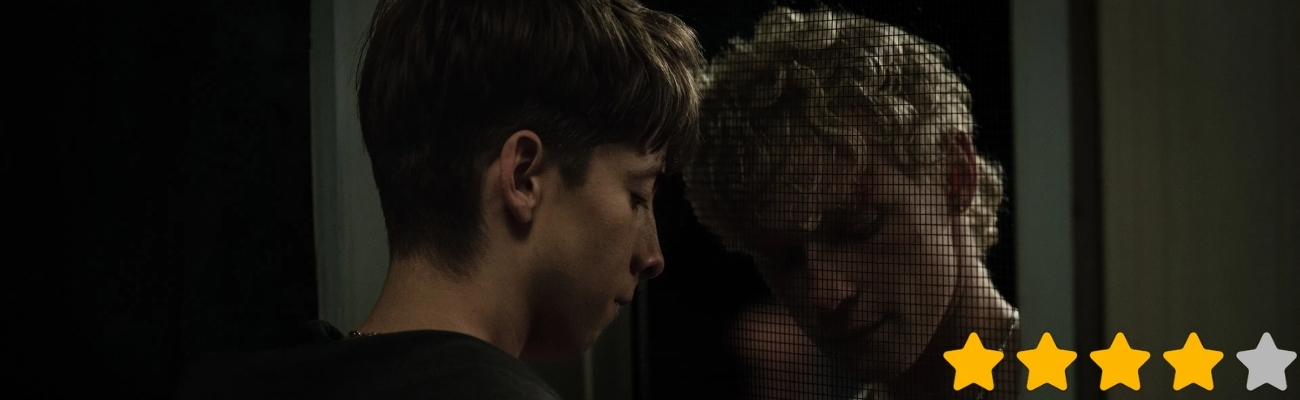
Here, the two young lovers are Naim (Joe Bird), who’s recently moved to an evangelical community in Victoria, Australia with his mother Arlene (Mia Wasikowska), and local fellow teen Ryan (Stacy Clausen). Their attraction is mutual, until a spontaneous fit of jealousy eventually leads to both of them, as well as Hunter (Jeremy Blewitt) who happens to be the son of the local pastor Rob (Ewen Leslie), being cursed by a religious “deliverance healer” who seeks to remove their sinful ways via exorcism. Now, the two boys find themselves tormented by a mysterious demon that only they can see which takes the form of the very person they desire the most: each other.
It’s a simple premise, essentially a mixture of It Follows and fellow “Ozploitation” horror like the Philippou brothers’ Talk to Me (which Bird also appears in), that happens to be executed very well, as Chiarella cleverly reflects the endless cycle that numerous members of the gay community have no doubt experienced at least once in their lives. Naim and Ryan’s blossoming romance is at first a perfectly pleasant frolic that harms absolutely nobody, but it’s when outside forces get involved who are a lot more closed-minded and outright intolerant of certain lifestyles that everything starts to unravel for them, leading to endless persecution and judgement that can cause far more harm than it ever intended to be. Chiarella’s script is perhaps too blunt in underlying the commentary it’s trying to make – here being that the shape-shifting demon is a manifestation of bigots enforcing fear and self-hatred among a culture that they just don’t like – but it’s how the filmmaker brings that concept into a story of young queer love amidst societal oppression that makes it quite unique and, in many ways, much more horrifying to watch unfold.
That is because you do initially like these two characters whenever they’re together, acting all boisterous but flirtatious at the same time, with real sweetness to their confidence and naivety about the world around them. So, to see them recoil at the sight of one another later on, since there’s a 50/50 chance that the other person might be a bloodthirsty monster pretending to be them that their homophobic community has summoned, is both chilling but also heartbreaking. Even when it’s clear that they are their true selves, there’s always a worry at the back of your mind (and theirs, too) that the demon has gotten a little too good at emulating one or the other, which Chiarella and especially actors Joe Bird and Stacy Clausen (both delivering a pair of excellent co-lead performances) use to their advantage as their mannerisms and stern poker-faces always leave you uncertain until the moment it becomes clear who they truly are.
It’s definitely a case where the idea and its underlying themes are scarier than the actual movie, which isn’t really a problem that sinks Leviticus in any way, but it does cause a bit of a leak when you become more eager for more effective scares than the film itself can offer. There are a few horror conventions that the movie likes to throw in, like the fake-out dream sequence and a prominent building being set on fire during the climax to symbolise the destruction of something close to a character’s heart, and while they’re decently shot with dark and moody cinematography as well as a few interesting editing choices, they often don’t fit the more subdued level of horror that fills the rest of the movie. The concept itself was even done a little better in It Follows, since there the transforming demon could take the form of anyone close to the infected person instead of just the one person they happen to be most attracted to (which as stated in this film could also be movie star crushes or mere acquaintances that briefly passed by), making the uncertainty of it all much more frightening than in this film.
Like I said, though, Leviticus will leave you feeling angry more than scared. And that is very much the point. While it is a well-made, brilliantly acted and overall effective slice of social horror, it is a film that shows the lengths to which bigotry – an evil that’s arguably worse than any demonic entity – will go in order to persecute, punish and inflict pain and suffering upon those who pose no real threat to them or anyone else. And that, more than anything, is bound to inspire all sorts of anger.
SO, TO SUM UP…
Leviticus is a well-made and brilliantly acted social horror where the terror – or more accurately, the anger – comes from its clever commentary on homophobic oppression and the harmful effects it can have on the queer community, forming a supernatural concept where its ideas and themes are often scarier than the actual movie.



Other recent reviews:


0 Comments