

Teenage Sex and Death at Camp Miasma (dir. Jane Schoenbrun)

Certificate: 15
Running Time: 112 mins
UK Distributor: MUBI
UK Release Date: 21 August 2026
WHO’S IN TEENAGE SEX AND DEATH AT CAMP MIASMA?
Hannah Einbinder, Gillian Anderson, Jack Haven, Patrick Foschler, Arthur Conti, Eva Victor, Zach Cherry, Sarah Sherman, Dylan Baker, Jasmin Savoy Brown, Quintessa Swindell, Kevin McDonald, Ryan McEwen, Louise Weard, Amanda Fix
WHO’S BEHIND THE CAMERA?
Jane Schoenbrun (director, writer), Dede Gardner and Jeremy Kleiner (producers), Alex G (composer), Eric K. Yue (cinematographer), Graham Mason (editor)
WHAT’S IT ABOUT?
A filmmaker (Einbinder) connects with the reclusive star (Anderson) of a slasher franchise…
WHAT ARE MY THOUGHTS ON TEENAGE SEX AND DEATH AT CAMP MIASMA?
While I didn’t think it was an awful movie by any means, or even a mildly bad one, I just couldn’t connect with filmmaker Jane Schoenbrun’s previous breakout film I Saw the TV Glow as much as others did. I do think it’s very much a “me” problem, since its heavily queer themes and transgender allegories, not to mention Schoenbrun’s vividly surreal filmmaking and storytelling style, weren’t immediately identifiable to me as a cisgender heterosexual viewer, as well as someone who perhaps favours a more straightforward narrative instead of that cerebral approach popularised by the likes of David Lynch.
But luckily, Schoenbrun’s follow-up feature Teenage Sex and Death at Camp Miasma – a movie that is about movies, one of my favourite kinds – is something I could get on board with much easier. While the filmmaker’s overtly queer screen identity is more overt than ever, as is their appetite for trippy visuals and out-there concepts, the film is a wholly unique deconstruction of the classic slasher template, one that eschews a more traditional film-student analysis and instead breaks it down to its two core essentials – which are, as one character bluntly puts it, “flesh and fluids.”
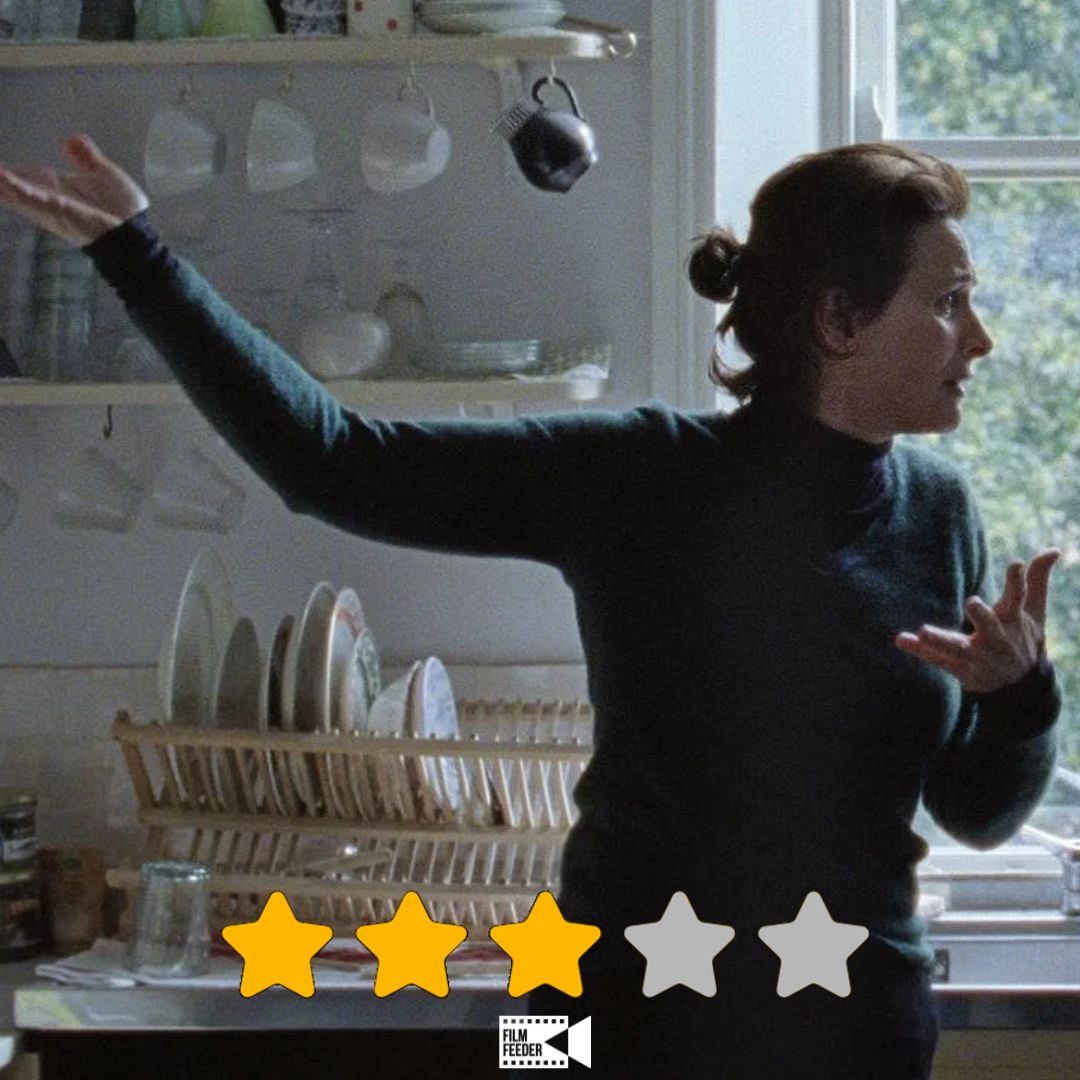
Said character is Billy Presley (Gillian Anderson), who was once upon a time the original star of a popular slasher called Camp Miasma, wherein a supernatural killer with an air vent for a head called Little Death rises from the nearby lake and lays slaughter to the hard-partying and sexually active counsellors of the nearby summer camp. It’s essentially Friday the 13th, right down to the same title font used on all the promotional material, as well as how it too spawned a franchise made up of increasingly derivative entries before the entire IP was put on ice. This is where we’re introduced to Kris (Hannah Einbinder), a young queer filmmaker who’s been hired to reboot the franchise and give it a more favourable lens following controversy over the original’s queerphobic subtext, and who seeks out Presley – who abruptly retired from acting after the first movie and has since become a recluse living at the very campsite where they shot the original film – to potentially reprise her role.
From there, you’d think that Teenage Sex and Death at Camp Miasma would gradually turn into its own kind of meta slasher movie, the kind you’ve seen everyone from Wes Craven to Christopher Landon make where they spend a majority of the movie pointing out all the usual tropes before then simply becoming the very movie they’ve been analysing. It does in some parts, sometimes to an almost irritating degree that threatens to take you right out of the film (example: after a lengthy build-up, a character suddenly declares that this would be the perfect time for a jump-scare, instead of… well, a jump-scare). But rather than settle for that familiar structure, Schoenbrun uses the opportunity to explore the slasher ethos from a more sensual angle, one that goes much further than just depicting horny teens having sex and then being slaughtered for partaking in such things.
As their characters, both Einbinder and Anderson – who are great together, by the way – share such a deep fascination for the slasher ethos, from a nostalgic and traumatic perspective respectively, that it gradually becomes some kind of psychosexual aphrodisiac for them as their bond grows much more sensual. A unique fetish is effectively crafted by them as their combined experiences with the typical slasher template, Kris being an avid viewer and Billy a reluctant participant, merge into an intentionally schlocky bloodbath that sees the walls between fantasy and reality come crumbling down, with Little Death and their serving as some kind of catalyst for both women and their longing for not just pleasure but also that overwhelming feeling of trepidation that comes from being fully embedded in the slasher mindset. Schoenbrun, perhaps in response to the long and infamous history of sexuality within slasher movies, presents it not as something to be fatally punished for but as something to embrace and even be reborn from, something that they embed in everything from the strange matte-painted backdrops that glisten with the characters’ unspoken desire, to the wildly over-the-top gore where decapitated bodies spray out blood like water fountains, all the way down to the inexplicable eroticising of KFC dipping sauces.
Schoenbrun’s slasher recontextualisation is, like I Saw the TV Glow before it, going to baffle people as well as fascinate them. Its surreal nature and wholly ambiguous manner, especially in a climax where you’re never entirely certain of where things are going, is both visually striking to watch but also head-scratchingly confusing. However, the journey you’re on is fun and metatextual enough, with references left and right to slashers both famous and obscure (not just Sleepaway Camp but both its inferior sequels get a considerable shoutout) as well as a real passion in how Schoenbrun recreates the grainy, split diopter-filled aesthetic of 70s and 80s slashers giving it serious firepower that will at the very least win over cinephiles of pure, unadulterated schlock.
In a way, it’s the most passionate love letter to slasher cinema ever crafted, with this one reading a lot racier than your average valentine.
SO, TO SUM UP…
Teenage Sex and Death at Camp Miasma is a fascinating recontextualisation of the slasher genre that sees filmmaker Jane Schoenbrun apply a much more erotically queer lens to the formula that shakes it up to a point where it feels as fresh as it did in its heyday.


Other recent reviews:


0 Comments